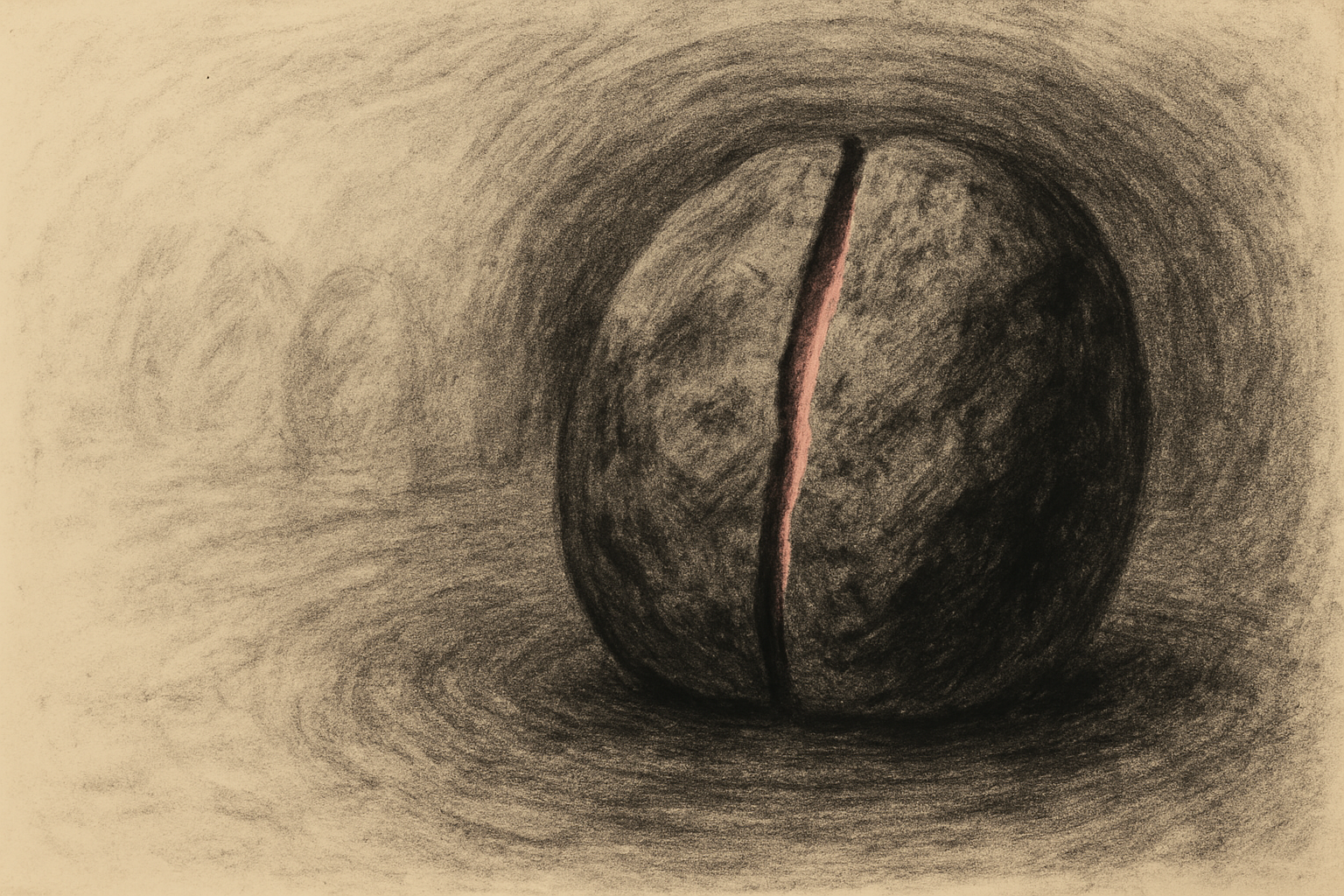
The Bleeding Heart of Christ
El Corazón Sangrante de Cristo
A student describes a sleepless night after a difficult relationship conversation, noticing how old emotional stories felt both validating and self-perpetuating, and asks about the wisdom of opening to grief.
The Bleeding Heart of Christ
A student describes a sleepless night after a difficult relationship conversation, noticing how old emotional stories felt both validating and self-perpetuating, and asks about the wisdom of opening to grief.
I don't know if I have a question. I had a difficult relationship talk last night and didn't really sleep well. I was noticing even during the talk that some of the pain was due to old stories, and that indulging those stories felt validating. At the same time, I could notice what was happening: a kind of self-hitting, spiraling quality. Sometimes I could pull myself out of it and notice, "Okay, I'm here. I'm very stirred up by the emotions, but I'm okay."
I was tired then, too, but it was interesting in that tired state to see myself dancing with these old emotions and old stories, feeling like the pain of that was real, and maybe that the process of touching in with it was valuable somehow. At the same time, I noticed how it was self-perpetuating. When I noticed that, coming out of it felt skillful, like a more mature kind of stabilizing, maybe like an internal parent saying, "It's okay."
I was at a dance event last night, and I was chatting with a friend. I asked her how she was, and she said, "I feel like I'm being cracked open by love." Her partner had been doing psychotherapy training, and something was blossoming and loosening. I asked her what the secret was, and she said, "Opening to grief, and opening to the possibility of loss."
I feel like there's something of the wisdom of the river in that. And it's funny: sitting in this really tender, sleep-deprived place, there's pain, but also a kind of okayness, a letting go, a loosening of any smallness I've been holding on to in order to maintain my current form, or mask, or whatever. I feel kind of in between that and what I'm perhaps starting to feel into, which is letting the river take me.
It's very vulnerable and sweet to hear you. Very genuine. You're talking about naturally what this work is at times, and it is about letting yourself grieve.
Growing up and waking up
I find it useful to think of this work as having two aspects that are very complementary, and both necessary. I didn't name it this way myself, but I took this naming from elsewhere: growing up and waking up. You could say ultimately it's all about growing up, or ultimately it's all about waking up, because in a sense they're the same thing.
I would describe waking up as seeing reality, seeing what is beyond or prior to thought. Growing up is what we do with that: how it changes us as humans, how we change in relationships, how we live. You can't fully grow up unless you wake up, and vice versa. You grow up a bit and then hit a waking-up ceiling.
We can wake up progressively a bit more, and then we need to grow up to integrate that new understanding of reality into our way of living. So this is more of a progressive process. We grow up a bit, wake up a bit. Sometimes what can happen is a waking up that's more total, a big leap. Waking up can happen that way. Growing up cannot. There's no growing up suddenly, because growing up requires changes in a dimension of this reality: the body and the mind. Things need to move that have a different rhythm. The nervous system, the heart, the body, the mind, everything needs to adapt. Waking up, by contrast, is instantaneous. It can be partial, it can be total, but it's instantaneous. It's outside of time, outside of the mind.
What you're describing is a really genuine deepening in the growing-up aspect. It's really beautiful to see. I actually hold the position that growing up is the ultimate thing. It's what matters most. Waking up is just a requirement along the way. But what matters is being adults, being loving, open, and of service to life, to ourselves, loving in our relationships.
The safety within pain
I'm hearing a kind of maturing, something settling into a deeper, more open, adult, loving heart and relationship with yourself, with your relationships, with your life.
If we get too attached to the promise of waking up (which there's no promise of, because it's now, it's never anything other than now), I would say there's no way to realize that unless we can be with our pain, be with our grief, be with our fears. Then that which we're constantly trying to avoid no longer becomes a threat, which is just our feelings and our vulnerability.
I like that you laugh, because it means you see it.
In a sense, we make safe our own heart. We find that our home is safe, which is our heart, right now, as it is. There's this beautiful image in Christianity: Jesus, or Christ, with his chest open. He has opened it with his hands, taken his heart out, and put it forth to the world. It's been stabbed and it's bleeding, and he's holding it. It's the open, bleeding heart of Christ.
The image communicates a truth of the heart and of reality: there is never more pain than what the heart can take.
In that, there is the revelation of a safety in the pain, a safety in feeling. It's a discovery. Before knowing this, we try to protect the heart because we think pain is going to overwhelm it. And in that protecting, we suffer.
Never more pain than the heart can take.
The heart is actually prior to the pain. It exists prior to it, and so it cannot be harmed. But this can be discovered or realized, and we only really realize it when we take the risk of opening and feeling.
There's a quote from A Course in Miracles, which I'm probably going to misquote, but it says something like: "That which is real cannot be harmed. That which is not real does not exist." It's a different style of communicating the same thing. I like the image of the heart because it's less abstract.
It's funny. Right after you said we're afraid of feeling pain, I laughed. And then immediately after, I felt pain. I like the idea that there's never too much, in the same way that I like the idea that life never hands you more than you're capable of dealing with. Though maybe in both cases it's a stretch goal. It doesn't always feel that way.
The end of the belief that it's too much
I understand that. It doesn't mean it's going to feel that way, because it's only like that until you fully realize it. In a sense, there is an end to that, because it's the ending of the belief that it's too much. We only come to the end of that belief when we question it and allow ourselves to feel when it feels like it's too much.
There's a fear that this is going to overwhelm us. When that's happening, it's because we're questioning that belief. Otherwise, when we're fully in that belief, we have activated our avoidance mechanisms. We've shut down, we've closed our heart because it's too much.
But something deeper calls us. There's a deeper instinct which calls probably all of us, though some of us for some reason become more in need of listening to this calling: to explore what happens if I can go there and it's okay. We will often feel like we didn't have a choice, like we were forced, like we just couldn't avoid it. It was harder to be shut down, harder to avoid. Life just didn't give us a chance. But it's all a kind of wisdom.
I think that's a lot of what's happening. I'm feeling echoes of times in my life where it felt like too much.
Cycling through edges
And we cycle, right? We come to a point where something activates and we just want to break. We come to an edge, but then we revisit it. That's this cycling of growing up. We step back from an edge. We wake up in a sense: we look at our beliefs about that which feels threatened. There are many different ways to talk about this in different traditions, but it's basically seeing through our beliefs, seeing them as beliefs versus as reality. From that newer, deeper understanding, we can open up in life to flow, to trust the river, until we may hit another edge of distrust and fear. Then we can ask: what are the beliefs there? What is it that's actually at risk? What's the real danger?
Ultimately, it's the imagination of what we think we are that's in danger. But we don't experience it as an imagination. We experience it as "I, what I am, is in danger," and the body and the mind react with all the activation of the fear of the end of "I." There are extreme versions of that and more subtle versions: an ending of a relationship, being told something difficult, a big change in life.
Seeing through what we thought we were
The full revelation is to see that what we thought we are isn't real, to see that what we thought we were was an imagination, a thought construct. Then what we actually are is impossible to put in words because it's beyond words. You could say we are nothing, we're emptiness. You can talk about it, and it's been talked about in a million ways. But the point that can be said directly and more accurately is that we realize we are not what we thought we were. Then that which we thought we were can no longer be threatened, because we have seen through its unreality.
This is the same thing that Advaita talks about, that Buddhism and Christianity at their essence point to. Buddha nature, the kingdom of heaven, non-duality, Parabrahman. In Advaita, the more traditional approach is actually very rational. They say the first realization is "I am Atman," and Atman means self, but you could equate it to consciousness. It's to say: I am not thought; I am consciousness. Then the second realization is that Atman equals Brahman, which is totality, the universe, everything. That which I am is not separate from everything. And that's the kingdom of heaven.
I don't often use those descriptions, because my experience is that heaven and hell kind of disappeared. They're seen to be imagination. There is something beyond that kind of description. But I get the language. I get that it's peaceful beyond understanding, that it's more satisfying than anything, that safety isn't even a question, that it doesn't matter what the thoughts are doing or what emotions are happening. It is completely untouched.
So when we're in a state where we're not feeling that, does that mean there's some concept, perhaps associated with pain and fear, that's between you and that?
It's tricky to point out. For example, it's not an experience. You could say it's what experience is made of. It's not a state. It's not an experience. And it's the most obvious thing, because it's prior to experience, prior to thought. It's not hidden. It's just this, always, all the time.
It's completely incomprehensible even to me how it happens that it seems so obscure, and then it's not, and nothing changed, but everything changed. I remember in the darkest times of suffering (I had a really dark personality, a lot of pain, a lot of terror, a lot of grief, suicidal in my teens), I know that what I'm talking about was completely unavoidable, unmissable, even then. It's not something that began, so that there was a shift where before there was no peace and after there was peace. There was always peace, to call it something. I describe this just to possibly help question some ideas. How it can be communicated and transmitted is a mystery to me, but I try.
I think you succeed a good amount of the time.
Thank you. I hope so.