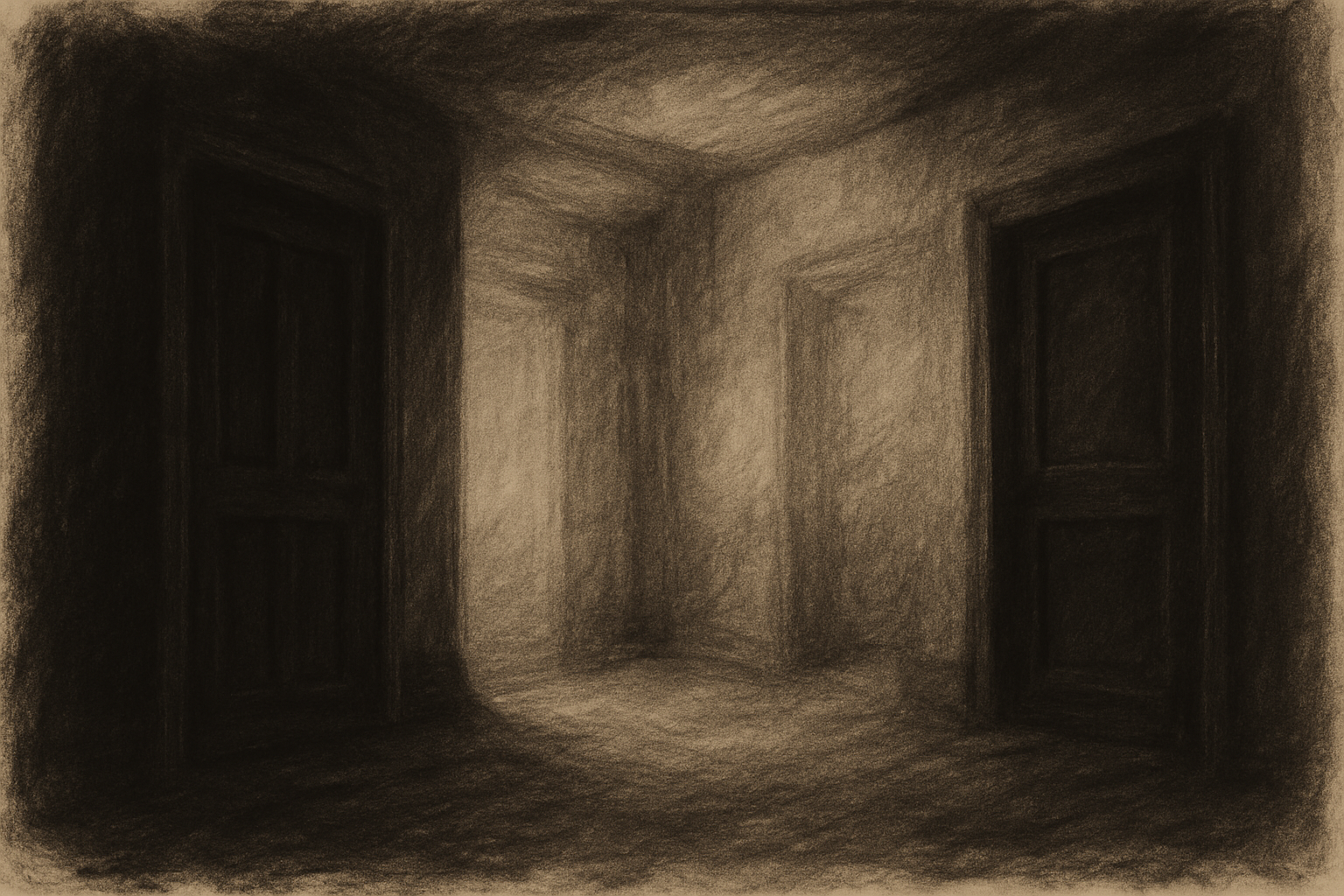
The Room with Two Doors
La habitación con dos puertas
A conversation about reactivity in family conflict, and how the belief in only two options, withdrawal or explosion, hides the many creative responses that become visible once we stop taking our interpretations as reality.
The Room with Two Doors
A conversation about reactivity in family conflict, and how the belief in only two options, withdrawal or explosion, hides the many creative responses that become visible once we stop taking our interpretations as reality.
I feel like I get glimpses of that from time to time, and it's fleeting.
Those glimpses are the seeds that keep you looking. That's usually how it happens, through glimpses. What matters is that each glimpse helps you learn more and more where to look, so that increasingly you are looking for what you're looking for here, as opposed to in future relationships, or in psychology, or even in spirituality. If I meditate ten thousand hours, that's not it. Meditating is looking for what is here, what is true, what is real here.
Then you sit, and the experience is: something's wrong, something's missing, it's me, I have to fix it. Thoughts, thoughts, thoughts. That is meditation: to see that those are thoughts, that this is not reality. Reality is sounds, sensations, breath, mind. The thoughts themselves are reality too. All of that is reality.
Perception versus the named object
Take an example. I have a thermos here. I look at the thermos, and I experience sight with a thermos. If my experience is "I'm looking at a thermos, that's what's happening, that's all it is, that's reality," then the fundamental truth becomes "thermos," and that is illusion.
Now, if my experience is perception, sight, then the experience is a miraculous appearance of something that has a particular form, which I know intellectually to be called a thermos. I also know that the calling of it "thermos" is a thought, is the mind. So now I am experiencing perception, sight, and at the same time experiencing thoughts, words, concepts, names. At the same time I'm experiencing sounds: there's a garbage truck, more perceptions, more sounds, more sensations in the body, and more thoughts. There's the day, there's work, there's life, all of that held in thought. Right now, all of my past, all of my future, the whole setting, that is all thought.
That is a more accurate description of reality, where the fundamental nature of what all of this is, is: I have no clue. I only know what I know. I can only know through thought, and I know that thought is only an interpretation. That is all I can know. The form of knowing that is mind is an interpretation. It is limited. It is an approximation.
Why relationships feel crushing
You talk about waking up and growing up and moving into life. When I try to move into life, namely in relationships, I just get crushed. It's crushing for me. I can't hold on to that sense of non-judgment, of non-interpreting, when I'm relating.
You don't need to. You don't need to hold on to anything. All you need to do is notice. It's not about not judging. It's not about not having a judgmental thought. It's about noticing that this is a judgmental thought, that it's nothing more and nothing less than a judgmental thought. That kind of knowing is not thought-based. It's a knowing more appropriately called seeing: seeing reality.
A judgmental thought appears. If I'm not seeing reality, then the judgment is reality. The judgment becomes what reality is, and therefore all of the energy of what I am will function to feed the limited perspective of that judgment. That judgment becomes a false knowing, a knowing of the mind where a limited perspective is made real.
But if I'm seeing through the other kind of knowing, which is wisdom, wakefulness, I will see this as a judgmental thought. And I have no need to remove it. There's no need for it to go away. All I need to see is what is happening, and what's happening is a judgmental thought. From there, the mystery of what I am is not restricted to operate only at the level of judgment. I'm using judgment as one example, but this applies to all thoughts, all energies, all emotions, all of what the mind is doing.
So I can simply notice: oh, there's really intense judgment right now of my friend or my relative in this conversation. By seeing "this is just judgment," there's a freedom to not put all my energy into it. Whereas if I'm believing that judgment and thinking it's reality, there is no alternative.
Right.
All of the energy of what I am is in the path of judgment, with no alternative. Whereas if I see "that's judgment," I can also ask: what are all the other ways this could be interpreted? If one is not identified and attached, the mind can come up with many different alternatives, alternative interpretations, alternative paths of action.
But if I'm convinced that the reality is judgment, then the actions this body-mind has available are limited by judgment. The narrative is: that person is wrong, I am right. So what options are available? When choice happens, it will be bound only by the options of judgment. I am right in this way, you are wrong in that way.
Now, if I can see "these are thoughts of judgment," I can also see what other interpretations are possible, or the ways I might not be seeing something that this person is seeing. The more this non-identification is available to us, the more freely the mind can see all perspectives. Then, when choice happens, it won't be bound by a limited perspective.
The loop of mutual hurt
Usually what happens is that, within the judgment, the belief amplifies the feeling of hurt and makes the other the cause of that pain. The actions reinforce it and provoke a reaction in the other that reinforces the pain. Then we are in a loop of hurting each other, because everything I'm describing is happening to the other person as well. All the illusions, the judgment, the sense that something is missing. They feel you're the problem, you think they're the problem. From this come interpersonal wars, and wars between countries.
What if my tendency is not to cause conflict, not to speak up for myself, and then to regret it later because I didn't establish a healthy boundary?
You're just bringing up a different story, a different narrative, with the same problem at its root. Now it's not about judgment, now we move on to "I'm avoidant." So the interpretation "I'm avoidant," the behavior of avoidance, is the same thing in a different story.
It's the same in the sense that I'm judging myself rather than judging others.
Don't just flip it. It's not only two options, that you judge or you're judged. The human mind has infinite possibilities of narratives, ways of functioning, paths of storytelling. The one you're referring to is "I'm avoiding conflict." Let's say: now I'm not judgmental, I'm conflict-avoidant. The issue is, I'm in a relationship, and the problem is all about me avoiding conflict and not setting boundaries.
See how you're creating a narrative that what's missing, what's wrong, is a tendency that you have, particularly you, especially you: that you are conflict-avoidant and can't set boundaries, and if only you could, then you would finally be okay. If that narrative is believed to be true, and now you're trying to avoid conflict, you have a very limited set of options for how to behave, which is: what do I need to do to avoid conflict?
The room with one door
Let's say you are a divine creation, God embodied right now, but you are put in a room with only two doors, maybe even one. You, as divine creation, manifesting willingly in a room with one door, are free, but the conditions you have created are one door, or maybe two. In your ultimate freedom, you've restricted your conditions to one door. It's not even an option: stay in the room or walk through the door. What can you do? At some point, choice will either stay or walk out the door. That's all that is possible.
The room with one or two doors is the mind. If your interpretation of this reality is "I, in the room, am conflict-avoidant, and I need to walk through the door that avoids conflict," there is only one option: avoid conflict.
Now, if you realize "I'm just in the perspective, in the mind's interpretation that what I need to do is avoid conflict," then as soon as you see that, the light shines on all the other doors, the paths where maybe there's conflict. Suddenly the room is full of doors. They're doors that look like "yeah, probably conflict there, maybe conflict there," but now you have the ability to choose. You see the reality: there are many more options. Then the wisdom that you, as the divine creator, have can be free to display itself: "I think that door, the one that probably brings conflict, is actually the better one. Let's try that."
But be careful. Usually what happens is there's one perspective, "the door is to avoid conflict," and sometimes I switch to the opposite door, "now I'm fully in conflict." Either totally avoiding or totally in battle. It's the same limited perspective. I switch from one reality to the other: I'm avoiding conflict, or suddenly I'm triggered and in full rage.
I can see in my mind many possibilities of how I can interact in those situations. Often I'm thinking, okay, I can engage in this and get really riled up, or I could just sit here and not let it bother me, even though it's bothering me. I can see a multitude of things, and then I tend to disengage, because...
Withdraw.
I know I'm getting worked up.
Now we're going into specific patterns. Let's get to the root, otherwise we can go down a path of hypotheticals.
The problem is, I guess I'm just really reactive.
What is reactive? Withdrawing and disengagement isn't reactive in the same way. In a way it is, but I think what you mean is that you actually go into war.
I get super angry, and I'm afraid of what I'm going to do or say. I might blow up, because I'm going to cause some real family conflict, and then everyone's just going to see me as crazy. The story of me being crazy, the crazy one in the family.
Okay. So when you say you're avoidant, that's not really what's happening.
I don't want to cause this huge drama in the afternoon, after my brother invited me over for coffee and then my sister-in-law shows up and says all this stuff out of nowhere. The expectation is that I have to put up with it, even though I swore to myself I'm not going to engage with that anymore.
My point is, you're trying to avoid conflict. You are naturally, at times, rightfully hurt. Not righteously, but yes, it's going to be painful if somebody mistreats you or says something shitty. You might then feel you only have two options: either withdraw or explode in a rage.
And then I tell myself, you know what, she's going through a lot and she's taking it out on me.
All of that isn't going to work, because you need to find new, creative ways that aren't just withdrawing or exploding. Trying to explain where she's at, this kind of empathy of "well, she's doing this and taking it out on me," can be helpful later. If you're on your own and you find yourself ruminating, it's good to see that what that person is doing has nothing to do with you.
Yeah, I know that.
That's something you can do later. But in the moment, when your sister-in-law is there, your brother is there, and she's saying shitty things, doing that in that moment isn't useful. It's more avoidance.
That's what I've been taught my entire life: to put up with that, or else there'll be consequences.
What you're saying right now is explaining the mindset, the belief system, why you are in this room with one or two doors. I'm saying that is a belief system.
Wouldn't it be better to just, okay, I know this, I'm reacting, this is not what it appears to be, so let's just let it go?
No, because "let it go" is still the one door. You have the door of avoid, or the door of explode.
Explode is just taking all the energy out of me.
I'm not telling you to explode. I'm just showing you that you have a mindset, a belief system, that gives you only two options.
Right.
Right now you're only able to talk about this and think about it as two options: avoid or explode. I stay in the room, or I walk through the door into conflict. Staying in the room is withdrawal, avoidance, metaphorically. So when you say "I just have to understand that she had a hard day," or what you said before, "let it go," that's another avoidance strategy.
That's an avoidance strategy.
Somebody's telling you, "you're an idiot, you're really dumb," and it's like, "oh, let it go, let it go." No, that's avoidance. And going into a rage and punching them in the nose, that's going into rage. In between those two options, there's a multitude of opportunities, ways of being that are very unknown to you now.
Yeah, I guess in the heat of the moment, it's hard to be creative.
It's hard to be creative because you instantly go into the mindset of two options. That's the definition of not being creative.
And then later, after much ruminating, it's like, oh, I could have done this or said that. And now it's in me.
Exactly. All of that is the consequence of, in the moment, believing there are only two options.
Creativity as a third door
One example, and I'm not saying this is the way, but one creative response in those situations is humor. It requires you to really notice: oh, I am pulled into this belief system. This is what I was saying at the beginning, to notice. Now I see only two options. When you see that this is happening, you're going to see other options.
For example, with humor, just for fun's sake: if it's true and real in you that you are not reacting, that the reactivity is not what's leading you, you can say something back that's teasing or joking, with humor. But it has to come from a place that's freed up. It could completely change the energy and the dynamic. Something is said to you that's framed as "this is normal, everything's fine," but is actually criticizing you, which is what I imagine is happening with your sister-in-law. You can turn that into a bit of a roast, but from genuine, light humor. If you're not reacting, if you really see "okay, this is what's happening," you can engage with it creatively. How does a comedian deal with hecklers?
I can see a million ways I could have played that out.
My point is, see that this is the world of possibilities. Don't worry about yesterday. You're going to have many opportunities to practice being a comedian dealing with a heckler. The reason I use this example is that it's not about you winning. Otherwise I'd be giving you a strategy for how to fight back and win.
No, I know. It's to relax the one who...
It's a path where, in the end, everybody feels better, because the heckler, who was triggered and attacked the comedian, ends up having that belief system dismantled. They probably end up laughing at themselves, everybody else laughs, and there's a spreading of a certain joy, a bringing of lightness. I'm using this metaphorically, but that's another option. That's a third door.
Yeah, in my next life.
It's not in your next life. You're witty. Just be witty. But watch out with your anger.
Yeah, that's the thing I'm afraid of most.
Working with anger
The anger is when you lost it. You're completely in a belief system and you explode, and that's when you lost it. Very rarely is an expression of anger appropriate, though depending on the context, sometimes it is. It depends on the context. But when you're with family and exploding in rages, it's often triggered, not the true anger that is actually needed. Sometimes it is. I'm trying not to create beliefs around anger.
When you have a tendency to avoid because you're going to explode, you're afraid of your own rage, because you know you'll get triggered. You get triggered because you're in pain. So you have to notice what's happening: something is being said that is probably explicitly mean, or in some way directed at you. Often we're just interpreting these things, but people are mean, and people do say nasty things. Sisters-in-law do say nasty things to their husband's sisters. These are real. So that behavior is better if it's addressed. But how we address it is not by reacting, by withdrawing, which is avoiding, or by exploding, where the other person is made into the cause of all our pain.
In fact, our pain is actually our belief in what they are saying. There's a difference between "they said something unkind about me, and that doesn't feel good," and "the pain is so deep." The deep pain comes because it's hitting a belief I already hold. Only that true, deep belief in the negative things about myself can invoke that level of pain. If somebody says I'm an idiot, and I think, "yeah, I can see how I sometimes say stupid things, it doesn't feel nice to be told, but in that moment I don't think I was being an idiot," that's different.
No, she's very vicious about my son. He's completely innocent.
So she criticizes your son, and through that, criticizes you as a mother.
I feel like I've taken over this entire group today.
That's fine, I'm continuing because I think this is valuable. It's very generalizable, for anybody. All of it.
I just feel really selfish. Sorry, I've made you into my therapist now.
It's not therapy.
I really struggle with deciding what's the right thing to do. Sometimes I feel I should just allow myself to get angry.
Only if you're really present and clear, versus reactive and explosive.
What I really wanted to say was, why are you saying that about my son? What has he ever done to deserve such comments? I know that deep down she's hurting for other reasons, but still, that behavior is not acceptable. It's not okay with me. I feel like I'm the only one who sees this, and everyone just enables her.
Just find creative responses, and explore that.
I'm not witty enough. This is why I just withdraw from people.
But you're withdrawing from your own anger and your own pain. And trying to tell her she's wrong isn't going to solve anything.
No. No. It's just beyond me, I feel. There's nothing I can do.
Find creative ways. See that you have other options.