The Imagined Audience
La Audiencia Imaginada
A question about social fear, the wish to control how others see us, and the self-created loop of tension and release that underlies it.
The Imagined Audience
A question about social fear, the wish to control how others see us, and the self-created loop of tension and release that underlies it.
I don't have a question. I just felt like some exposure therapy, maybe. Being in the spotlight has always been triggering for me. Speaking up, with all these lovely people now listening and looking at me, has felt very scary and dangerous.
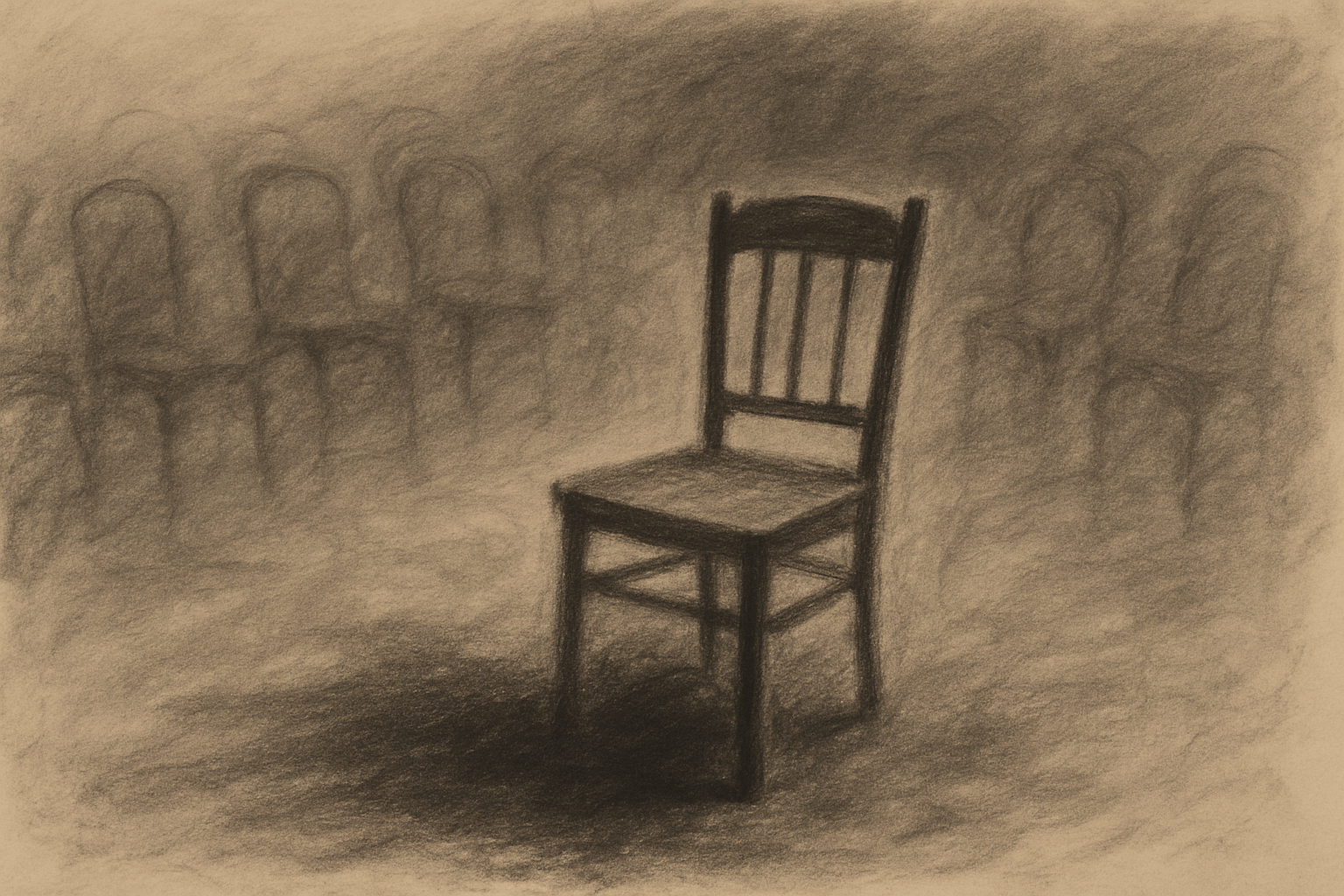
It's rather pretty, though, isn't it? The ghosts of the mind.
Yes, but it sucked for a lot of my life.
I know that very well. I was so shy, in terror of any kind of social interaction. I couldn't even call a friend by name. I had to tap them on the shoulder.
That sounds a bit familiar. I've tried to explore where the fear actually comes from, whether that helps or not. It's about how I come across to others, how this "Barney" character appears to them. Maybe as stupid, or laughed at. There's a fear of tripping up, of going bright red and everyone seeing that I'm really nervous.
The others are imagination
There are ways to work with that which could help you cope and change it progressively. But ultimately the antidote is to question some of the fundamental assumptions that make it real.
The me?
Yes, that's true. But there are ways to do that less directly. The me is the fundamental assumption, but it's the bigger one, the harder one to see. So in this sense, you could look instead at the assumptions you have of others, because you used the word "others": how others see you. You could see that the others you are worried about are your imagination. The inner world of the other that is judging you is one hundred percent your imagination.
Yes, I know exactly what you mean.
Even if somebody is judging you, that thought is their own imagination of you. They have an imagination, an interpretation, of the character Barney. Then you have an imagination of what they are imagining. It's all imagination. It's all human imagination. So you can see how, ninety-nine point nine percent of the time, the thing you're worried about is your own imagination. You're concerned with your own imagination, imagining a scary or dangerous thing.
There's something protective in it.
You'll see that as well. At first it feels like it's happening to me: I'm worried about something real, something important. Then you start to see that it's actually your imagination of what's happening, your imagination of other people's thought bubbles. And then: is it a big deal? Does it really matter for the imaginations you have of other people's imagination to be the way you want them to be?
Yes.
So why does it matter? And here's a clue: why is it that it's negative? Why does it happen to be a negative thing, rather than you going around imagining everybody is having the loveliest thoughts about you, so that you feel good all the time because you imagine everyone loves you and thinks you're brilliant? Why does it happen to be negative? Wonder whether you're actually choosing that, preferring the side that is negative. And if you find that maybe you are, then wonder why.
What comes to mind is experiences from when I was younger.
I get it, but it's about what's happening now. Even if you say it's because of a memory, refer to anything from the past as what's happening now. There's a memory of a pain, a situation where there was some judgment of some sort.
There's always something to touch on there. It's almost to do with a relief afterwards.
A relief of what, for example?
Like moving away from the situation that is fearful. I'm not sure. And it feels like there's something to do with attention.
The push and pull of attention
So now there is a seeking, a wanting.
Yes, to have positive attention. Attention, but then it clashes a bit with the fear of not wanting attention.
So it's a kind of push and pull around others' attention. Even negative attention is a form of attention. Even if there's a judgment, it's a form of attention. Now we're getting to the root of it without going into past conditioning or trauma. It becomes about what's actually happening now: a seeking, a wanting to control and manipulate the attention of others, for it to be a particular way. Preferably positive, but maybe also preferred even if it's negative.
I notice there's an addiction. There's even a kind of dopamine release, something chemical. It's a bit of a hit.
The loop of tension and release
So now you start to see there's a mechanism in thought that you're engaging with, feeding, creating, looping. It doesn't really have to do with another, or with the past. You mentioned dopamine, and you mentioned relief. You may have heard me use the metaphor before: the only way I can have the experience of relief, of "ah, that feels nice," after clenching my fist for twenty minutes, or twenty days, or twenty years, is by first contracting.
Something likes the pleasant sensation.
Of course. So in order to get that pleasant sensation of relief, you need to create the tension, then find a way to release it, then create it again so you can release it again. This is a metaphor, and you'll find in yourself what it refers to. It's the fear, the worry, the pain when you start to believe people are having a negative thought about you. It has a certain taste that you interpret as unwanted, but it's actually being created so that you can then release it.
It's pretty fucked up.
In the Eastern traditions this is called ignorance. It is pretty fucked up. I'm laughing because it's the human condition. It's not particular or special to you. It's the mind.
Why? Is it about the contrast, or more about the hit?
It's about the hit, because the mind has forgotten the true satisfaction you already have. When the true satisfaction is forgotten or overlooked, there's a sense of something missing. And what gets closest to filling it is that sense of release. It has many forms, shapes, and flavors. We call it pleasure, and it can be purely mind-created. This addictive mechanism can be just in thought: a negative thought, then a positive thought, and you create the cycle. Or it can be with experience. Depending on the personality, some people need more things actually happening in life, while for others it can be a purely internal, subjective experience, using thought alone to create it. Ultimately, it only matters that the thought process happens, and then the hormones and chemicals shift.
It's a real catch-22, then, because that's what causes suffering.
Yes, the suffering is self-inflicted, but it's ignorance in the sense of not knowing. There's a forgetting. And through the misunderstanding, we try to do the right thing, and it creates suffering. So the antidote is to see what we're talking about, which I think you already see thoroughly enough. You don't need to see it more than you already do. From there, just recognize that activity, that temptation. "Oh, there it is again. Oh, there it is. Oh, wow, even that one. Oh, that deep, intense one, that was the same thing. That horrible thing I've been in for an hour, or a day, it's more of the same." It's just imagination running through this mechanism.
This is the worst of my life.
It needs to be seen with humor: "Wow, that's what I've been doing."
The impossible problem
This happened to me very literally. When I saw a similar mechanism, more specifically how it worked in me, I saw it totally, and it came with a seeing of no-self. The core of that mechanism is the creation of I, I, I. "I am the one seeking this." That tension and release has the sense of I at its core. You can't have one without the other.
One thing I noticed is that it requires the attempt to solve an impossible problem. So you have to give up.
Yes. You can create this struggle, and create the mental contraction of the false I, perpetually. If you could actually solve the problem, it would be walking to the end of you. So it's the choosing of something impossible. For example, I don't know how it would be in you, but it might be finally achieving and knowing that everybody likes you. Not only that it's a fact, but that you will know it and have evidence of it. Everybody could totally love you, everyone who has ever seen you, but how could you know? And even if you achieve it, how could you be sure? It's an impossible problem. You can never be certain.
So now there's a perpetual search, because if somebody likes you, you can't really know whether they've just changed their mind. They liked you a minute ago. Since you can't know, the search never ends. And it's all imagination-based, all thought-based, all your interpretation and beliefs. You're the director, producer, and actor of your own inner movie. You can create the sense of tension and release that any good movie creates, where tension builds and then resolves and we feel something. But you can do this in your own imagination non-stop.
Seeing the whole mechanism
When I saw this tendency in me, I had an extremely obsessive, very specific type of obsession. When I saw it, I had a big glimpse of no-self. I didn't know at the time that's what had happened, but what I knew as I disappeared. Right before it, I saw my whole life, the way they say you do when you're about to die. I literally saw, from being a very young child, how I had been obsessing about this, thinking, thinking, thinking, as far back as I can remember, and how the whole narrative of my life was that obsessive thinking. I, I, I. Then it disappeared, and I disappeared into everything. Then the sense of I came back. This was about twenty years ago. But now I knew what was real. I knew that what I had been imagining was not real, that the I which was struggling, I saw the whole mechanism, how it's just imagination, self-created attachment, creating spikes of fear and then release, spikes of fear and then release.
A little "poor me" just popped up there.
And then it's straight back into the same narrative, with Barney appearing.
Yes. Immediate.
Immediate. What matters is not for that to stop appearing. It's just to see: "Oh, the imagination Barney, unliked or unwanted. Oh, the imagination Barney being liked right now." Sometimes there's a real moment where somebody is clearly expressing that they like you, and you're having a lovely time. I'm not talking about that. I'm talking about the ninety-nine percent of the time you're imagining it. These mechanisms are extremely fundamental. If you really look at this and see through it, the whole house of cards can come down with this one thing.
Discomfort as another version
Is it the same when there's a discomfort? I just felt a discomfort in my arm, and it was like...
It's a different mechanism, but a similar one: the creating of the interpretation that it's a problem and needs to stop. When you create that interpretation, that the sensation is tension, is a problem, needs to stop, there's a micro-seeking. There's this contraction in the hand: "This is a problem, this needs to stop." And whenever it releases, there's "Oh, good, I did it. I got it to happen." I, I, I.
The sunk cost
What you mentioned, about it being a waste of life, that's often a barrier, and you're seeing through it. We need to be willing to see how much we've invested in something that doesn't work. There's a temptation not to see that we've been burning time, life, and energy into something that doesn't work. Be willing to see it and be okay with that, rather than: "I'm not okay with that, so I don't want to see it, so I'll go back to trying the thing again." The sadness here is the disillusion. It's literally the ending of the illusion, and that's the healthy way. In other circles they call it the sunk cost fallacy. Are you familiar with it?
No. Can you say it again?
The sunk cost fallacy. Someone in investing will know what I mean. You invest in a stock, and it starts going down. But you keep the investment going because you've already invested so much and you don't want to lose. So you keep losing, but you'd rather hold on, hoping that at some point it works.
It's that pride, or something.
No, it's an attachment to not losing. What we're talking about is, in a sense, the sunk cost fallacy. We've invested so much into seeking, controlling, thinking, me, me, me. To see how absolutely pointless it is, and how much time, how many years, how much life was sunk into it, is pretty brutal. So we'd rather not see it, and keep sinking more life into it, hoping that maybe it works, maybe what they're telling me isn't true.
I'm not sure I can avoid seeing it anymore.
That's the good thing. When you started saying "wow," you were describing the seeing of it, which showed me you're quite willing to let it go. When you say "I invested all my life in this," and you feel sadness, that's a really good sign. It's like, "I'm done with it. I'm going to pull my investment and take the loss." But then later you realize you gain everything, because there really is no past and nothing was lost. You just wake up from the dream that there was something.
Was there ever anything lost?
That's just another story. But it's part of a process the mind often needs to go through. There's often a need to move through the fear, the loss of self.
I've been touching that recently. It doesn't feel too bad. There's something about seeing the self keep reinstating itself, and something keeps having to attend to it, so it dissolves, and then fear comes. But it feels more like staying really clear.
Yes. Then you see one of the foundational mechanisms of how you are selfing, contracting. Once you see through it, it unravels by itself. You can't unsee it.
Like any thought that reinstates identity.
It can, if you believe it, if you see it as real in some way. Almost every thought contains a whole narrative with a self, a me, an other, and time, past and future.
I don't know what to make of it.
It's fine to think, as long as you know it's thought. Thinking is great. Thinking is beautiful. The mind is amazing. Imagination is amazing. Like sound, like sensation, like sight, it's miraculous. Thought is miraculous. The trouble comes only when we believe our thoughts to be reality. Anything else, Barney?
That covered a lot. Thank you.
And thank you for a very vulnerable, courageous sharing. Truly.