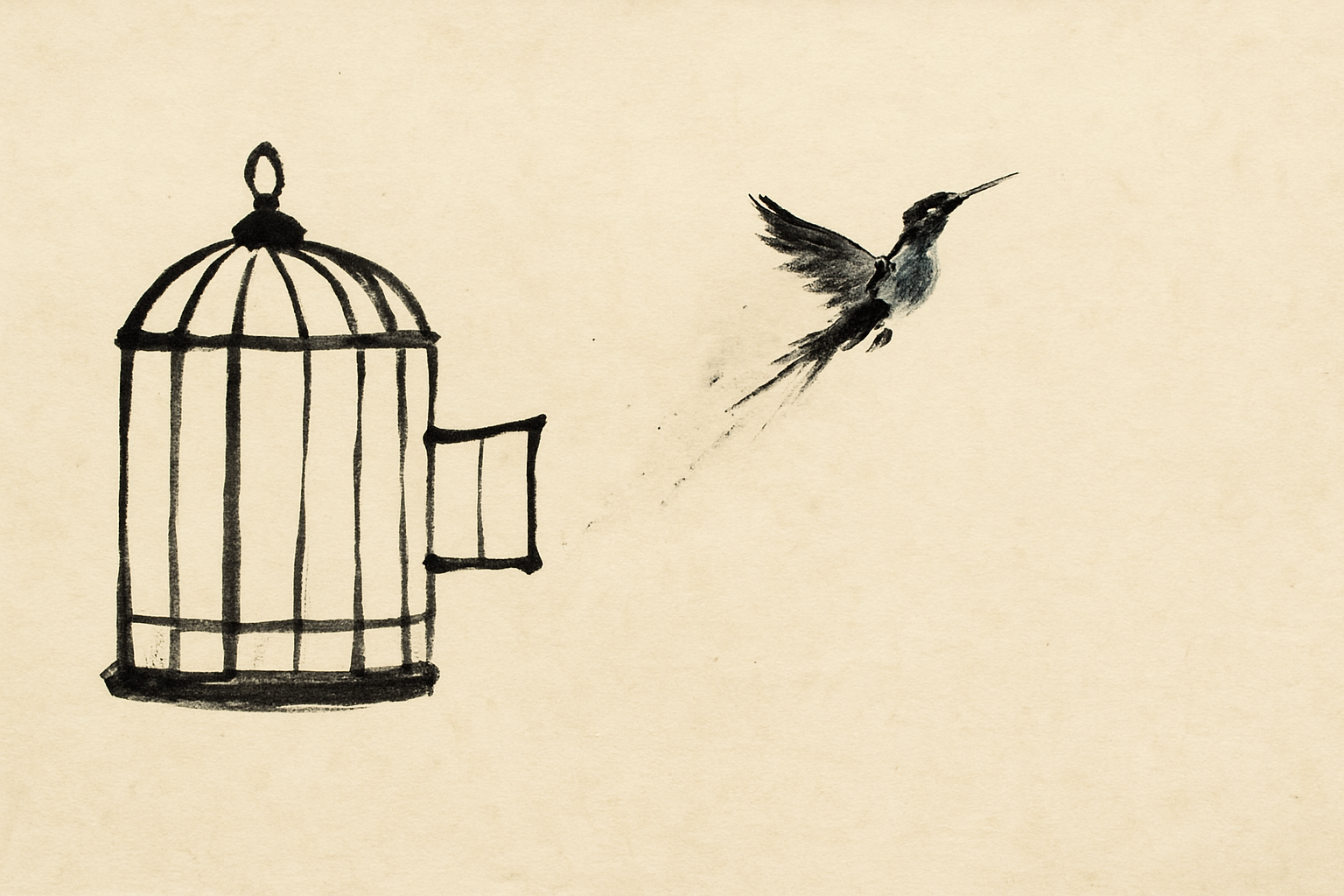
A More Spacious Cage
Una jaula más espaciosa
A conversation about suffering and its true resolution: why peace that depends on conditions is not freedom, how the fear of death guards every cherished narrative, and the difference between making the cage more comfortable and flying out of it entirely.
A More Spacious Cage
A conversation about suffering and its true resolution: why peace that depends on conditions is not freedom, how the fear of death guards every cherished narrative, and the difference between making the cage more comfortable and flying out of it entirely.
How hell is created
It's not that there's no feeling of at-homeness. There's hell around me, but my heart is still beating, and open.
And know that the hell is not absolute reality, because a process is a transition. Open, then, to the hell around you. There is a lot of pain around, and that pain can be turned into hell through fear, in others or of others. I'm speaking specifically about the mechanism through which hell is created: pain and fear, and the subjective experience in others, which you know in yourself.
The experience of hell in myself. That's all I really know at the end of the day: my subjective experience of hell.
That's why I gently pushed back on the notion that there is hell in others. All we can know is how hell is created in us, and then assume it is similar in others. You can't fully know. What you can know is that it can resolve in yourself. Then, through sharing that resolution, you can see it resolving in others, and that can validate and confirm its truth. Otherwise, if you resolve the hell in you in ways that are not true and then share that with others, it's delusion. It does not resolve hell in others, because it isn't true. Then it's the spreading of delusion.
And the way to know is to look at the nature of that experience of resolution. Is there really deep well-being and peace, or is it dependent on conditions?
Peace that depends on conditions
Am I someone spreading something?
This happens at every level. To be very clear: take the belief in money as the resolution of hell. A society completely immersed in the belief that if I had more financial wealth, my hell would end.
Someone close to me says, "Bro, money is everything." He says it half jokingly, but he says it.
It's the same with everything. It happens with the very common belief that if we found true love, the right relationship, that would be the ending of my personal hell. Finally, I will be loved in the way I'm wanting and needing. And then we can go in and out of multiple relationships believing that each one just wasn't the right one.
But this is looking for peace and well-being in circumstances: someone will give us something specific, all kinds of conditions. When I'm able to preserve those circumstances, then I am at peace, then I have well-being. But it's easily lost, and quickly, depending on the skills of the person. Some people are able to preserve something for a very long time.
You go on a lot of vacations.
Yes, but it's not true well-being. It's not true peace. There is going to be an ongoing distress, and this is no secret. So many people who have achieved everything they wanted are very explicitly unhappy, or in fear and distress: the fear of losing the relationship, the fear of losing the money, or even the fame, the attention.
Or the need to tell everybody, "Look how happy I am."
This is all of what I'm referring to as the spreading of the false, which just keeps people more in the delusion. As opposed to what I wanted to focus on: when you really discover the end of hell in yourself, truly, through truth, through real freedom, then that can be shared.
Being present with someone near death
I can already start to see it in my family. My mother was diagnosed with cancer, and just by my being around, not always reacting in the ways others normally do, something shifts. There's so much reaction around her, and I'm simply there: okay, what next? And there's something in her that becomes easier about it.
Yes. And the more you are with her, fully immersed in the intimacy of the moments together, sharing, communicating, sensations, sounds, fully immersed in the mystery and magic of the moment, enjoying and celebrating the experience of being together, no matter what's happening, no matter how difficult it might be, no matter if there's friction in the relationship, or pain, or fear coming up in her, or in you, or in both. The more there is this deepening, this celebration of shared aliveness, the more she will be called to it. Just the presence of that.
And somebody who is close to death often has a much deeper availability to that intimacy and presence. Somebody with cancer will be contemplating death, and the possibility of death, more than somebody who is healthy. So there is going to be more openness to what that implies.
Which leads straight back to the present, basically.
Yes. You could be invoking and bringing presence, and she might go there in an instant, and she might actually bring you more deeply into it. Then it becomes a synergy where you are both bringing each other, and yourselves, deeper and deeper into presence. It's the implication of the preciousness of this moment, which is often more available to someone who is contemplating death. And the contemplation of death is just a path, a way in which freedom can be tasted more deeply.
Death and the end of a narrative
Why is that? Because it's the ending of something?
It's a way to look directly at the cage, at the beliefs, because we are believing what is false in order to avoid something. The body mind is hardwired to avoid death, the death of the body. The way that is experienced is through intense fear; the body activates the instinct of survival to preserve itself.
Something happens when we are identified with a certain narrative. If I'm identified with being rich, or poor, whatever it is, then at the ending of that narrative the body will react in the same way. It cannot distinguish. The same mechanism is activated.
Like "I'm just alone in the world" as a narrative.
Yes. That narrative is a cage, and it's a way to protect against the experience of intimacy with others. Intimacy with others is the end of the narrative "I am alone." So true intimacy will feel like death. It will be terrifying. The body will experience a movement in that direction as if walking toward a lion.
And that's another narrative.
No, the reaction of fear in the body is just a natural, instinctual reaction. The mind cannot distinguish between the interpretation "what I am is going to end because a lion eats me" and "what I am is going to end because what I am is alone, and now I could not be alone." In both narratives, there is the end of "I." There isn't any distinction.
The mechanism of illusion
This is why film is so powerful. We can experience in our body mind the feelings and emotions, as if we were living what the characters in the film are living, to a degree.
And it means we don't have to live them.
I'm not criticizing the experience of watching a movie. I'm saying it shows you that the experience can be fictional and still have the same effect as reality.
But back in reality, I'm not viewing things the same way.
No, you're avoiding feeling in reality. If that's how you're living, experiencing only through narrative, through storytelling, that's a form of avoidance. My point is that all that's required is a subtle identification with a character, and then we have the experience as if we were that. The body responds. It's very easy to do.
What matters is to see and understand how that mechanism happens, the mechanism of illusion, where things feel real and they're not. So when you are metaphorically moving in the direction of what you want, flying out of the cage, it may feel like you're going to die. But it's an illusion.
But I'm just so immersed in it.
Just because you believe it. That's the only reason.
What can be known about death
And the root of it is the belief about what death is. We don't know what death is. We know the body dies; that's factual, no need to question it. But what happens when the body dies? We don't know. In fact, what you can know is that it's not the end of you. But you can't know it through thought. You can know directly that it cannot be the end.
And you don't necessarily need a close encounter with death for that?
No. What can happen is that all the beliefs about what death is can be seen to be beliefs.
So it's through the death of a belief.
No, the belief doesn't die. It's the ending of the belief in a sense, but the belief is just a thought. What happens is that we can see it as reality, or we can see it as a thought. There are basically two kinds of beliefs about death: either what I am ends completely, or what I am continues in some specific way. Both are beliefs.
So the truth is both, and none of it?
You can't put the truth in words, because then it becomes more belief. But there is a kind of knowing that is not belief-based: I don't know what death is. I cannot know what the death of the body is. I cannot know what happens. But what I am cannot end.
It's just awareness.
We can have a lot of ideas about what awareness is, so it's not that. We hear people talking about loving awareness. I prefer to call it mystery, or the unknowable, because if we describe it, the mind will create an image of what that is.
Box it up.
It will create an image, and then there will be a false belief that we understand what is being referred to.
The part that doesn't want to wake up
Just talking with you, I can see that in some ways I'm heading toward something real and true. And at the same time, I see my desire to snap out of it, to just carry on with the same things.
The illusions. Again, I highlight the things that are important: it's really significant that you recognize your interest, investment, and desire in preserving the illusion, in staying in it.
It's very common for people drawn to this work to adopt a belief expressed as: "I really, really want to wake up. I just want to see truth and dissolve all illusion. That's all I want." It's not true. There is a part of us in this process that wants that. But there's another part, and a lot of the time it says: I really do not want to wake up. I really do not want to see truth. Even while I'm telling myself this is all I want, a big, big part of me feeds and encourages the avoidance and the illusion. Part of me is very attached to the illusion and the resistance, and any challenge to it, I will fight like crazy. To see that other side is very important: the side that just wants to stay in the cage, to say it simply. Anybody telling me to fly out, I will resist. Even in a group where that is supposedly all we want and care about.
Yeah. I don't want it, a lot of the time.
Which is great to see, but it's important to see both. Otherwise the attachment to the illusion just operates hidden in the background; we pretend it's not there and don't look at it directly.
Like a denial.
Yes, and that denial is actually what keeps us in the illusion. If you look at that desire directly, then you can start to see through it, dissolve it, and understand why it's there.
I believe human connection is one of the strongest methods of awakening, you could say. Being with another person, and feeling safe enough to let go with them, is a transcending of oneself: out of our shells and into the mystery of another. By definition, that's a step toward and through awakening, because awakening is the falling away of the belief in what you are, and of its limitation.
Right. Most of our beliefs, not all of them, are connected to relationships somehow: beliefs about myself as a body, defined in a society by what I am in relationship to others and what others are. And the reason the illusion is there is to avoid the love that is here, the love that wants to pour through our hearts. That love is relational: with others, with everything.
Breath work: cleaning the window
That's why I love this area, breath work, and learning how to give in a way where I can guide people through it: just be present with them without necessarily giving advice. They're going through this journey, and I'm simply there with them.
Exactly. And the deeper you go in yourself, the deeper they will go while you're guiding them.
Even my own teacher, who is teaching me all kinds of things, I can see where he's caught in his illusions. So I try to learn what he's teaching without identifying with where he is. It's a very new idea I'm playing with.
That's great. Body work is a very powerful thing. I've done a lot of it, and it has been very valuable. It's a stepping stone.
Do you still use breathing techniques?
I do in retreats, when it's in person, but less than before. I used to do it a lot. With my teacher, we did breath work for hours and hours in retreat. It's a very powerful tool for clearing the stuckness in the body mind, the energetics and feelings.
It really helps break through belief systems. Or maybe only the surface-level ones.
No, it can go very deep. But it is still a way to alleviate. I wouldn't say it's a way to total freedom.
It doesn't necessarily encourage more freedom. It could just be: okay, I got relief, goodbye.
Yes, it can be a trap in that sense. It's basically like washing a window that you're trying to see through. Once the window is clear enough, you need to look, and want to look very closely, at what's on the other side. If the window is extremely mucky, it's hard to see at all. So the work helps clear what's in the way at the level of the body mind. But it's complex, because the dirtier the window, the more you want to see what's on the other side. The more suffering there is, the more you will want to address it and end it.
As the facilitator?
No, I'm talking about you, in your own process, not as a facilitator of anything. The more you are suffering, the more you will be called either to go even further into avoidance, or to find some way to address and resolve it. But if breath work clears that fear and pain and alleviates the suffering, you might become content living in a cage. You'll just have a slightly bigger cage.
A more spacious cage.
Yes. There's a risk that through that work, you simply manage to make a more spacious, more comfortable cage. What I talk about is freedom from it: metaphorically, to fly out of it completely.
Awakening without preparation
But can you even begin that journey until you see a little glimpse? At least for people who are really stuck in a lot of pain.
No, not necessarily. You cannot know. A person can be completely stuck in total pain, fear, and suffering, and then awaken, for no reason anyone could understand. This is a very common story in awakening.
There is a very well-known teacher who had absolutely no experience of meditation, body work, or breath work. No practice, no exposure to any spiritual tradition. What he had was intense suffering, to the point of contemplating suicide. And then he had a glimpse, a very total glimpse: complete self-realization in one moment, the moment he decided to look at what was happening. There was a complete looking, and truth, and it all ended in that moment, in one instant: all illusion and all suffering.
So there is an example of no process needed: no practice, no therapy, no breath work, no trauma work. And that is true freedom. Which doesn't mean there wasn't work afterward; there was, and he speaks about it a little. He sat with it for years and only started teaching long after.
That integration.
Once the illusion is seen through totally, it all happens on its own. My point is that some of this work, the breath work, can alleviate the suffering or the pain so that we can look more clearly, but it's not a requirement. And you can also be doing it as a way to avoid: to alleviate, and not look more deeply.
What do you really want?
So I guess we all need to ask why we're doing anything.
Each of us should ask: why am I training? Do I want to make money, or do I want to be freer? What do I really want?
I asked you at the beginning of this conversation, and I'll end with it. The question for you is: what do you really, deeply, truly want, in this moment, in this life? And look at all the ways in which you avoid that. This is not something you can find as a specific answer and then be done with. It's an energy. It's an aliveness. It's a question that is meant to be always open and alive. And the body mind aligned with that freedom, listening, connected to that deep energetic of vitality, will be like a child: playing, curious, joyfully celebrating, experiencing pleasures and pains and fears, falling, hurting, getting up, playing again, exploring. The fearlessness of going out, even when there's fear.
All of that is within something that I want.
The point of the question is to see that there are two poles. One is to stay in this cage of the mind, of my belief system. It's comfortable, and when at times it's very uncomfortable, I make the cage more comfortable, a little bigger. The other is the nature of what you are, which wants to fly out of it and be free. And that flying out has a manifestation in this life: how to be, what to live. It's hard to put into words, but it has to do with what calls you, what inspires you, what is expansive.
This breath work exploration could come from that, but it's not the answer in itself. It's a stepping stone: that, and then what, and then what else, and then what else. Relationships, life, work, projects, what to create, where.
Exactly. Not leaning everything on it.
Don't see it as a solution to anything. It's an exploration, an aliveness in movement.
I love that way of seeing things. Thank you so much.
Thank you for the conversation. I hope it helps.