The Bird Does Not Heal Inside the Cage
El Pájaro No Sana Dentro de la Jaula
A student describes a two-year-old grievance with a course organization over a certificate, a resentment he keeps returning to. The teacher asks what the stuckness is helping him avoid, and points to a freedom that does not wait for healing.
The Bird Does Not Heal Inside the Cage
A student describes a two-year-old grievance with a course organization over a certificate, a resentment he keeps returning to. The teacher asks what the stuckness is helping him avoid, and points to a freedom that does not wait for healing.
There's a place I've been going back to lately, a place I feel I get trapped in. It has to do with a course I did, and with money. I paid for a course and did it for two years, and at the end I didn't meet all the requirements to pass, but I did most of it, basically all of it. They didn't give me a certificate; instead they sent me an email with a certificate and said, "Print it out yourself." I was really pissed off, and it's been two years since then, and I still have this feeling of "How dare they?" I paid all that money. They should have at least printed me a piece of paper. There's this expectation that they should behave morally. I keep going back to this feeling of wanting to reach out and say something, that I should get my certificate. But I keep getting stuck by the feeling that I don't have the confidence to say it, that I won't be convincing, or that even if I am, they won't want to do it for me.
What the struggle is for
You can see how much stuckness there is here. The question is this: what is this struggle with this organization, this institution, helping you avoid today? And here the requirement is that you are absolutely, totally honest with yourself, because it's not with me. You can fool me.
Maybe responsibility.
Maybe. But what? Really take a risk. Maybe you're wrong, but take the risk. Don't be lukewarm; don't say "maybe, possibly." Take total risk to see the reality and truth of it right now.
Full responsibility for myself.
More specifically, what is it you're avoiding? And it's probably going to be a little scary or painful or sad to see. Don't think too much.
That people are limited, and that it's a responsibility on my end to accept people's limitations.
What is it helping you avoid today, in your life?
I know this is my blind spot.
Contemplate that. The freedom of action: total, free, responsible, loving action for yourself, in this moment and in this life.
That's what I was saying: responsibility for my actions.
Yes, it is responsibility. But responsibility is by definition the opposite of avoidance. So I'm asking what you're avoiding, and you say "responsibility." It's correct, but it's abstract and philosophical. I want you to see the actual thing, to see it more viscerally. What is the universal desire in me, the true desire in me? Where is it longing to go, this thing I am avoiding by focusing on a past narrative and feeling stuck? Because it's self-hypnosis, this being stuck.
The self-hypnosis of stuckness
It's like being on a couch, feeling tired and depressed and unmotivated, and it feels like it's happening to me. This whole psychic, emotional mood is happening to me and preventing me from getting up. I don't notice it; I just feel that only if I didn't feel this way could I get up. The reality is, you can just get up, in spite of everything you're feeling. But the self-hypnosis says, "I'm stuck in this whole thing." Which is what you presented at the beginning of your sharing.
Then the question would be: is there also a responsibility on my part to take action toward resolving this? Or do I just let go of the whole thing?
No, it's self-hypnosis. Of all the psychic struggles we go through, only a tiny fraction needs to be resolved through a process of grieving, and especially not now. Whatever needs to be resolved will come later, not prior to the free movement.
Let me say this differently. It is more self-hypnosis, more delusion, more self-denial and avoidance, to believe that. Go back to the metaphor: I'm stuck on the couch, and only when this resolves will I be able to get up. Now you're asking, "But don't I need to heal or resolve whatever issue has me stuck in that mood, so the mood will go away and I'll be able to get up?" No. You just get up, in spite of the mood.
There is a process that can happen, but after the fact, after there has been a dispelling of that dream, that illusion. It feels very real; it has chemical components in the body. The brain, through the belief system, releases substances. This is very clearly proven. You can watch a movie and be afraid of nothing. Nothing is really there, but the body will release the same chemicals as if there were a tiger right in front of you. It reacts in exactly the same way, with the same physical responses and sensations. But it's all in a dream.
Healing comes after flight, not before
So what you can do now is really explore: what is this free movement, in spite of the issue? Later, once you're freed from those belief systems, a deeper feeling can come about why you were stuck. But it comes later. It's a deeper knowing. Once the illusion goes, once you've stepped out, you might grieve something, or you might feel moments of a current of fear or terror. But it's not a requirement. You don't need to first grieve in order to step out. It's the other way around.
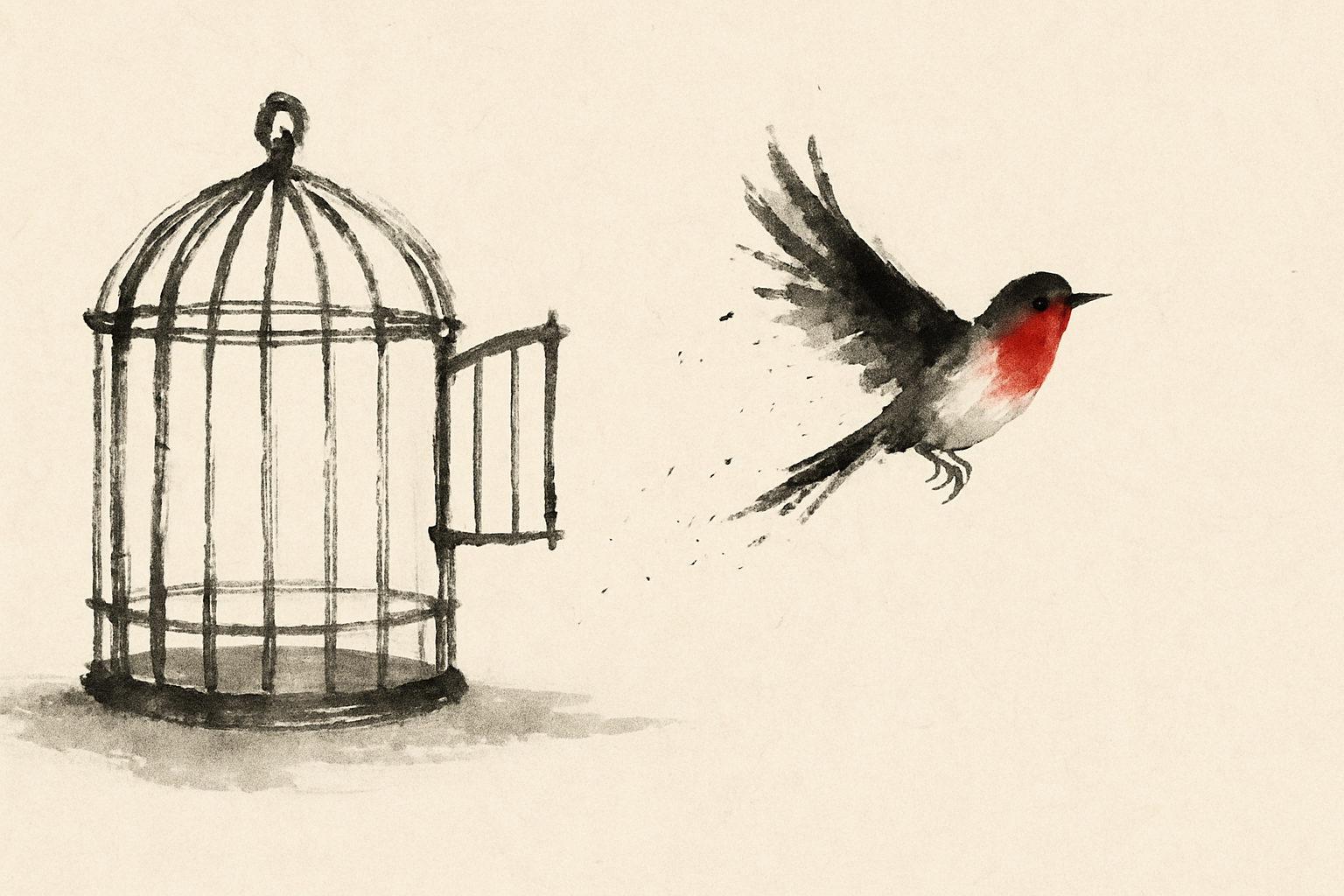
It's like a bird in a cage. The door is open. The bird is afraid to fly out, but it's also thinking, "I have to deal with the trauma that keeps me stuck in the cage, and then I'll be able to fly out." It's not true. First, fly out of the cage. Then, if there's anything to feel, it will be felt once you are free. Otherwise it's the same trap: the self-hypnosis keeping you in the mind, in the belief system, in the metaphorical cage.
Right. I can see how I've been living in that kind of cage for so long. Even when I step outside, it sometimes feels like I'm taking the cage with me.
Oh yes. The cage is in your mind. It goes with you wherever you go.
Sometimes even stepping out feels hopeless, and I don't want to do even that. But other times I feel there's no cage at all, and it feels limitless. Then something happens, and I'm back in the cage.
Yes, until you go deeper and see what it is, what edge you are facing, that sends you flying right back into the cage. It's going to be life. It's going to be risk-taking. It's going to be going for what you truly, deeply want, and the fears and pains that come with that. But it's what we crave. We crave aliveness and celebration. We crave doing what we really want to do, and I have to emphasize "really." It has to be the deep, true wanting; not what I believe I want or need, not what feels safe, not what the body-mind has been conditioned to believe it wants. What I really, really want. It's this life, right now. That's what my question, "What are you avoiding right now?", was pointing to.
Yeah. And in some ways I can begin to answer it. Lately I started a new course in breath work, circular breathing. I completed one, and it was amazing; the connection I felt with the people was beautiful. So I started another one, and this one has all these new challenges. It's much more information-based, and I'm facing those challenges mixed in with doing something I like, with the doubts that come with that, but also the excitement.
What is actually allowed
That could be just the beginning. What if you could do anything you wanted to do? The world is available. This life is here. And immediately notice any fear-based thoughts of limitation, of what's not possible, what's not available, what you can't do. As soon as this question is asked, the mind goes: "But not this. But not this. No, I can't. No, it's not." The more you were to speak those thoughts and I were to push, the more certainty would come, and the beliefs would be revealed about what's really not possible. That needs to be seen and challenged.
Right. Because essentially there are still places in me that are still in the cage, where I still feel limited to what's allowed.
What's allowed is your belief. It's your interpretation of the society you're in, and in your belief you are determined to have that be a truth. Think of the childlike curiosity that is defiant, curious, explorative, that is going to go where it wants no matter what the adults are saying. It's defiant, but also loving, based in a true, deep caring: fun, play, exploration, creativity.
One way to know what you truly want: it will be exciting. It will feel good, loving, alive. It won't go against the freedom of others; in fact, it will create freedom. It will create love and beauty for others as well. If it goes against the freedom of others, or brings true pain to others, it's not the thing. And by true pain I mean if it's hurtful. If I do something others don't like and they have some mental disapproval, that's not what I'm talking about. That's not true pain; that's more cage. When we're following the deepest, truest desires, they come from freedom and love, they are creativity, and they bring freedom and love to those around us.
Your example is an example of that. Breath work brings well-being to you, and sharing it brings well-being to others. But this is just one movement. Where does it go? What is the next thing? The bird flies out of the cage onto a tree, smells a flower, and then what else? There are more birds and flowers and trees and mountains.
The acquired taste of freedom
I guess you have to taste the rainbow.
Yes, you have to acquire the taste of freedom. When you're in that cage, flying out feels a little horrible at first. There's so much fear that the experience of freedom is quite displeasing, so it takes some getting used to. It's an acquired taste. But once it is tasted, there is more and more flying out of the cage, and less and less flying back.
I notice that more, and I also notice the pull to go back to the cage.
Yes, and that's fine. No need to judge it; just notice it: "Okay, now there's a bit of that going on." Sometimes you might need a little rest in the known, comfortable mind. Just know that's what it is, and know it's not really what you ultimately want. But there's no need to judge, no need to rush to resolve it.
Right. So I don't need to...
Ultimately there's nothing to resolve. It's just about doing what you want, as much as you want. But what you really want; this is where the mind can be very tricky. It says, "Oh, I really just want to sit on the couch and feel miserable."
I really wanted to do that for many years.
There's the wanting that comes from the body-mind addicted to avoiding pain and fear, and then there's the wanting I'm talking about: the true wanting. Call it the wanting of the soul, though I don't speak of soul for a few reasons. I would call it the universal wanting, because it's not coming from the body-mind. But our bodies and minds can become alive to it, awakened to it, and then aligned with it, moving freely. It's what we see in a child, what we see in animals that are free: a movement that is completely spontaneous and aligned with nature.
False knowing
Right. And ultimately, maybe everyone is always behaving from that place, and it's just that we have so much judgment about where they should be, which we project onto them, deciding they're not okay where they are.
In a way, yes. In a way, not. Most are not living from that place. But the fact that your mind is occupied with that judgment, with that interpretation, is your cage. It's a way to avoid. It's going into a place of knowing, of arrogance.
Right, that's my judgment.
It's your belief that keeps you in your trap. Your false knowing.
Which feels great.
To be in false knowing, but to believe one knows, feels great in a way. It is actually the root of all suffering. But when we are there and numb to its effects, it feels great, far better than the fear and pain of flying out of that system.
Yeah. I can just blame someone, and all my problems are solved.
Until you become more and more sensitized to the suffering you're in by doing that, the pain you're in by doing that, and possibly how you are spreading it. The spreading is a big one as well. When we are in suffering, in avoidance of fear and pain, in pain and in fear, those around us are affected. And this is what most people are doing. It's not black and white, but there's a lot of it. This is why there is this spreading of suffering and fear and pain.
Too much for me to handle.
No, it's not. That's a belief.
It feels like too much sometimes.
That's more correct. That's how you should interpret it: it feels like this is too much. Don't turn that into a belief. It feels like it's too much, but actually it's a fear.
I know I could handle it, but...
Notice it for what it is. When you say "it's too much" and then correct it to "it feels like too much," what actually is the feeling? The feeling is fear. It's an emotion. "What would happen if I move in this direction? Will I be okay? Will it turn out well? It probably won't. It's going to go wrong in these and these ways." It's future, future, fear, fear, fear, as opposed to simply acting out of trust.
Seeing fear as a belief
What matters is that you recognize it as a belief, and that it's fear-based. That is ninety percent of the work; I would say ninety-nine percent. Because the more you see things for what they are ("oh, this is a belief, and it's fear-based"), the more space opens for "well, I want to do it anyway; let's see what happens."
The bird in the cage sees all the birds flying out on a beautiful day, and it thinks, "But there's that cat, and there's that hawk. I'm definitely going to get eaten as soon as I fly out, so why even try? I don't think I can manage it. I don't even know how to fly. I'm going to get destroyed. I'm going to be run over by a car." The moment you see that as fear, you can say, "Actually, it's a belief. I don't know what's going to happen. What if it goes well? What if it doesn't go well, but it's a great experience, and it's fun and beautiful? I'm going to die anyway. Do I want to die in this cage, or be eaten by a hawk?"
That's what I mean by ninety-nine percent of the work: to see it as fear, as just a belief, fear-based. Then there's room to naturally say, "Actually, my nature as a bird is to fly in this world, not to be in a cage. I'll do what I want to do and enjoy it. Yes, I might have to fly really fast when the hawks come, and if I get destroyed by hawks, so what? Better that be the end than sitting here in this cage, avoiding." You're sitting in the cage waiting to heal from the fear of flying out before you fly, and that's never going to happen.
And with everything, there's going to be some form of fear or suffering.
Well, the fear and suffering is staying in the cage: not being free, not living, not flying.
I mean, with anything new there's going to be some anxiety, some interpretation of where this is going to go and whether I'll do well.
Yes, and that's just more fear. You just fly.
The threshold
I notice more situations now where I can see those fears, but once I'm in the situation, it's okay. It's not the same feeling as before. But sometimes there's still unbearable fear beforehand.
Yes, I get it. It's exactly that. When you're on the edge, standing at the door of the cage that's wide open, contemplating flying out, that's where the fear is greatest. That threshold. That's exactly how it is. But to expect that you can stay in the cage, heal some traumatic past, and then fly out without fear: that's a delusion. The healing happens after you fly out of the cage. Then you will be flying with experiences, living with experiences, that will bring about the resolution, over time, of anything that needs to be resolved. And most of it is just imagination: imagined threats. Ultimately it has to do with the fear of ending, that which we imagine when we think of death. But it's imagined.
There's a quote that comes to me: keeping our heart open in hell. It's comforting to know that, because I'm not expecting there to not be a hell.
Yes.