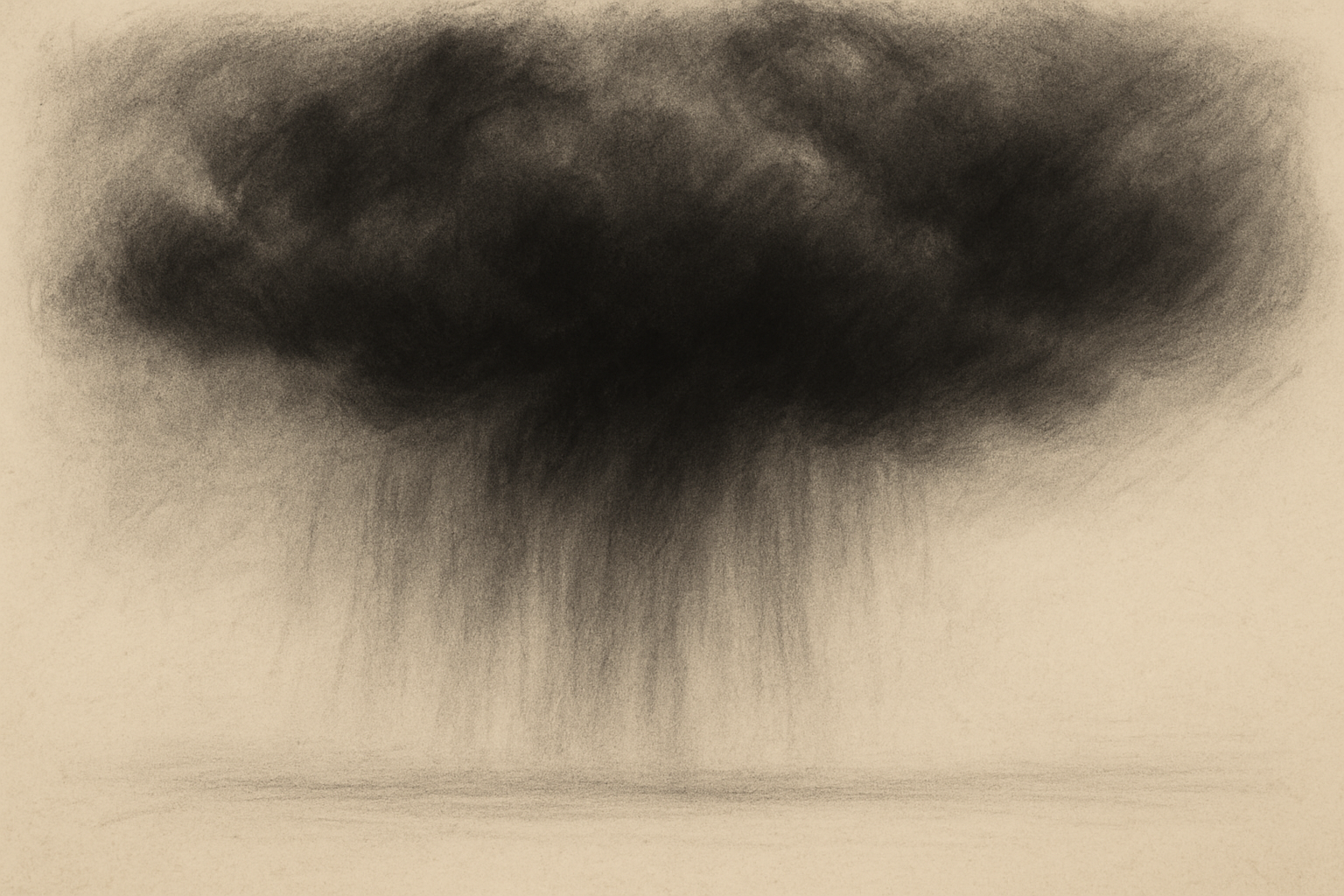
Choosing the Storm
Elegir la Tormenta
A student notices her leg falling asleep during meditation and the cascade of thoughts that follows. The dialogue turns to a surprising recognition: that suffering, at some level, is preferred and chosen.
Choosing the Storm
A student notices her leg falling asleep during meditation and the cascade of thoughts that follows. The dialogue turns to a surprising recognition: that suffering, at some level, is preferred and chosen.
I like this topic. Right now it feels very alive, like things I'm chewing on at the moment that have to do with relationship. During the meditation I noticed all sorts of things. I was very aware of different thoughts that were nagging me, wanting my attention, but also pushing them away at the same time. At one point I was sitting and my leg fell asleep. In my mind I thought, this is really annoying, why did my leg fall asleep? So I straightened it. Then a minute later the pins and needles came, and I was clenching, and I could see all the different thoughts about that coming up. I was trying to go back to my breath while all of that was happening, all the thoughts about my leg, about what it means to me that all of this is happening. I was feeling present with the desire not to be present with it, not to be present with the discomfort of all of that.
Being present with the discomfort. Here is a question. What was more uncomfortable, the pins and needles or the thoughts about the whole thing? If you had to choose one or the other, which would you choose? If you could have just the pins and needles, or just all of the stormy thoughts about it and no pins and needles, which would you choose?
Oh, good question. I want to say the thoughts about it. No, I'd rather have the pins and needles. But at the same time, my habit is to want the thoughts.
Let me say it again, so it's clear. You can choose to experience only the pins and needles and no thoughts about it, none of the negativity. Or no pins and needles, but all of the thoughts and negativity about it, about everything you were experiencing when that was happening, which probably was not just about the pins and needles. Which would you choose, if you could have one or the other? It's very interesting that it's not an easy question for you.
Yeah.
Let me reflect back what I heard you saying. "I think I would prefer to just have the pins and needles, but I also see how I'm attached to and want the thoughts." Is that it? You were hinting at that.
Yeah, something like that. So I'm torn.
The preference hidden inside suffering
You're torn. This is great. You can probably see that it would be nicer to just have the pins and needles as an experience. It's a little intense, but if there isn't any negativity in the thoughts and the reaction and the interpretation about it, the actual experience could be more pleasant. Just the pins and needles. But you realize, well, I kind of like that dark mind reaction I was having, the unpleasant negativity around it. So actually I'm not sure which I prefer.
Now you can start to see that you actually like all of the storminess, which traditionally is called suffering. What that can show you, which is one of the most powerful things anybody can ever see, is that there is an aspect where suffering is chosen. There is a preference, a liking of it.
Which kind of makes me sound crazy, maybe.
No. What I'm saying is the most normal thing.
A note on Advaita
There is a difference in traditions. Here we have a bit of a flavor of Advaita. I've been very close to and profoundly affected by Advaita teachers, though not exclusively. The teacher I've had longest was not Advaita.
Advaita is non-duality. Literally, it's a branch of Hinduism. Non-duality comes up a lot in more contemporary or mainstream spirituality. The word comes from the Sanskrit "Advaita," which is a very deep part of Hinduism. It's a very rational part, very much about logic, and so a lot of it is expressed almost mathematically. An Advaita term is negation. In math, when you say "not two," the number two, it means literally "not two." It's very literal.
Now, that is the answer to a question: what is reality? What they are trying to understand is the nature of reality, what is true and what is false. True and false are described as what is real and what is illusory. Only what is real is true; what is false is illusory. If you believe something that is not real, that is called ignorance.
Most people who talk about Advaita don't talk this way, because that is a more contemporary use. If you go deeper into the tradition, you start to see this language around what is reality, what is illusion, what is ignorance.
Inner integrity
Now, back to when you said you might seem crazy if you say things this way.
Maybe to people who are, like, to others, or to my family. I do like seeing all the parts that exist inside me, all the things that come up. I do like to notice them, to discover what they are.
If I were to reflect to you what I see, it's this. You said it might seem crazy because you revealed what I call inner integrity. That is being able and allowing yourself to see yourself without lying to yourself. Inner integrity is the most important area. I would say spirituality and inner integrity are almost the same thing. Anything related to awakening and inner integrity are the same thing.
Then there is what you could call external integrity, which is how we act and what we say. If I say to you something that is not true to what I believe or think, there's a failure of integrity in the external way. But for there to be any integrity in any way, there first needs to be inner integrity.
The fact that you are able to see what you just saw and said, and to say it, that's both internal and external. You revealed it in a group, one that is being recorded, by the way. You're anonymous; if anything goes out of here, it's anonymous, just so you know. It's very brave. But the part that is brave is not the most important. What matters is that you are describing and seeing the reality of your experience as it is, with deep transparency, deep authenticity, the inner integrity of that. That's why I'm highlighting it. It's quite rare. That's the opposite of ignorance.
Half the work
That's why I said: to be able to see how much we like the suffering is, I would say, fifty percent of the work needed to be free from it. Then all you need to do is contemplate it. Just notice it, keep noticing, and keep wondering. I wonder why. Just stay open. Why is it?
More and more you'll see, well, it's a choice. I wonder why. I can see it's a choice. I can see there's a preference. Most people interpret suffering as something that happens to them against their will, something they can do nothing about. Then there's a whole process I would work through with a person, to come to see more and more what you describe: it's actually not happening to me. It's something being created in my own experience. It's actually chosen and preferred. There's an attractiveness to it.
It's like something you said before, which I wrote down: loneliness, if met fully, can be transformed into love. It's that association I have with a certain thought or feeling. But if I can meet it fully and just sit with it, then suddenly there's a new experience of that thought.
And it's more than a thought. The loneliness is more than a thought. It's a deep human experience, deep feeling, deep sensations, deep heart energy. Energies that are really deep.
I guess that's a bigger example, as opposed to something very simple.
Like your leg falling asleep.
Right. That could be this tragic thing in my mind. Oh, my leg is falling asleep, this is terrible, this is the worst experience, why am I even sitting here? And then all of that storyline is just, oh, okay. Is my leg falling asleep?
Yes. When you have that big, traumatic, negative reaction, you can look more closely, curiously. Okay, I notice that I like that. There's some aspect of it that is liked, that there's an enjoyment of it. And then you can look: why is that? What is it about it?
The addiction to pain
It's very fascinating to notice all the different ways I'm still addicted to pain, to suffering, and to see how I'm pushing away from wanting to see that I'm addicted. But actually looking at it and sitting with it, maybe that's the beginning of something new.
It is. To see that on some level it's being chosen, being preferred, that's the addiction. I can see this isn't good for me, but I want it. I really want it. And I keep choosing it over and over again.
I think it also has to do with growing up in a very tense, chaotic home, where everything was done in an intensive way, with a lot of expectation and a lot of speed. Jumping fast from this to that. So what is making sense to me right now is, when I slow down, what is more accurate to my experience? What is more real?
More true and real.
Just playing with that. But I still believe what I believe, that I still need to function at this pace, that everything needs to be intense and done quickly. And yet I'm also seeing how I'm more able to do things that are a bit more intense, like going on a run, and still contain a presence the whole way through. So I'm seeing that this is a possibility too, that it's a lived experience.
Confidence from your own experience
That's fantastic. You can also see how that is new, something that's emerging. It can give you confidence that real shifts are possible, because you live it in your experience. If there's anything I want from these sessions, it's for you and anybody here to have moments where there is, to whatever degree, a shift, a change that you intuitively know is for the better. You just feel it. It could be called expansiveness, or lightness, or more truth, more authenticity, whatever it is in your experience.
Simplicity, maybe.
Whatever it is for you that feels like a shift for the better. That can give you confidence, because it's your own experience. It's no longer somebody telling you something is possible. In your own experience there's a shift. That gives you the encouragement and the freedom to see there is one more. And then I can say there are a lot more shifts possible, almost a never-ending one. "Improvement" is a weird word, but a never-ending shifting toward freedom. More love, more peace, more freedom.
Yeah, more spaciousness, in different areas of life maybe.
You might not realize it now, but with time, perhaps over many years, you'll see in hindsight, and by comparison with others you'll meet in life, that what you just described is very rare and very valuable. What I call inner integrity: the fact that you could see it and not deny it to yourself. First, to want to see it, to be able to see it, to acknowledge it, not deny it, admit it, allow it to be your reality, and then to communicate it in a group. That's very rare.
It feels...
In that sense, you are crazy. You are crazy because you're not normal. But this is where many traditions say the world is crazy. Normal people are crazy.
I feel so normal even talking about it with you and in this group.
That's the point. To create a space where what I consider normal, which is not normal in society, can exist. A space just for that kind of sharing, intimacy, connection, and communication.
Yeah. I'm grateful.
It's a pleasure for me. Thank you for sharing. I think that's a good moment to end. Thank you for joining. It's nice to see you all. Have a lovely day.