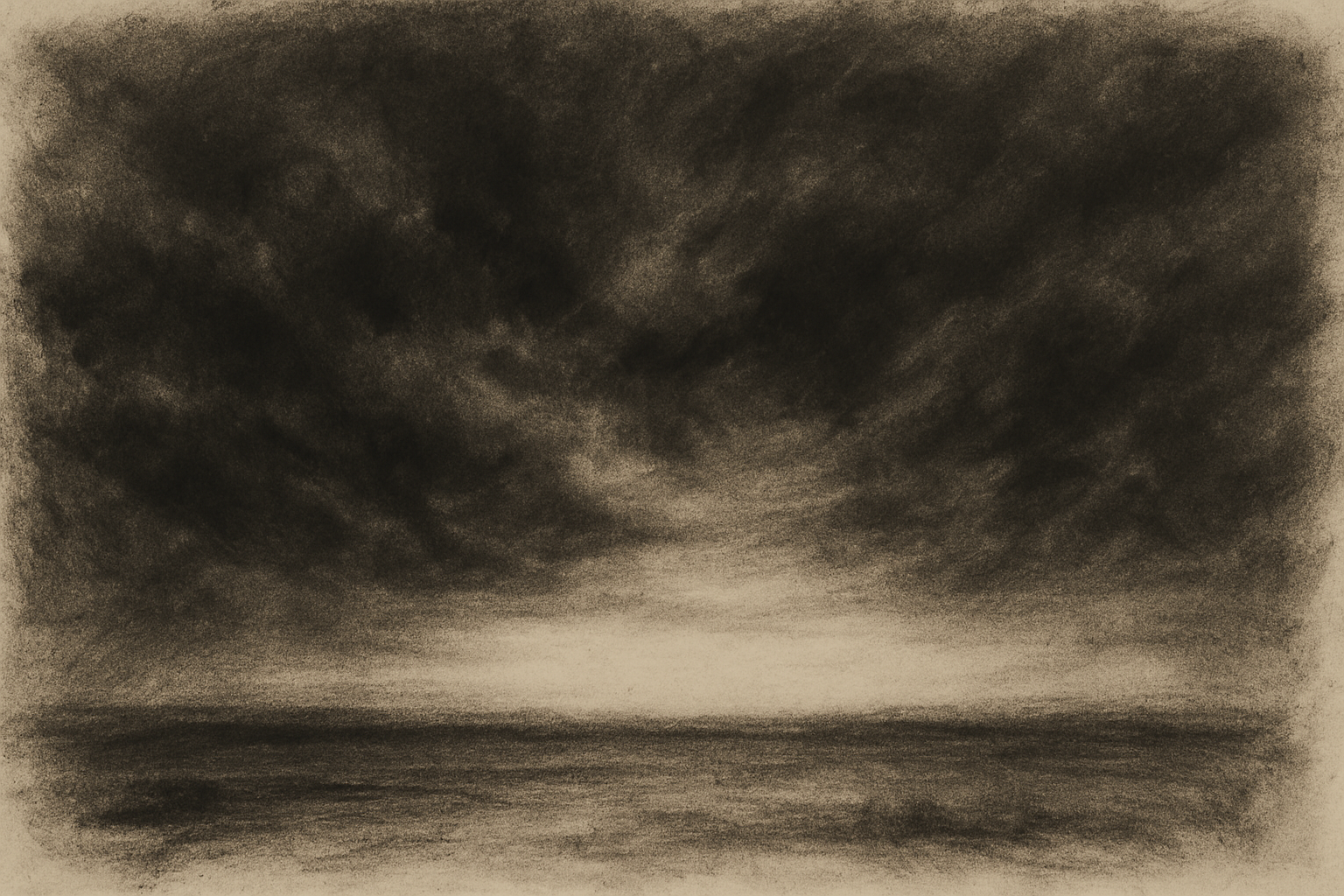
The Preference Beneath the Storm
La Preferencia Bajo la Tormenta
A question about why the mind returns so easily to imagined problems and difficulties, even when we recognize that what we are looking for is already present.
The Preference Beneath the Storm
A question about why the mind returns so easily to imagined problems and difficulties, even when we recognize that what we are looking for is already present.
It is very good to hear you again in this way. Your words bring me the possibility to perceive something more profound. I notice how easily I go out of this state of being immersed in just myself and in life. It is so easy to jump into problems, to run and invent difficulties. And I am not really there. It is not real.
Imagination.
And then I say, "Oh my God, I am losing so much time." I think it is a small disease of mine. So I tell myself, "Okay, I have to do the best I can to remember this." Thank you very much.
Thank you for sharing.
May I ask you a question? Why is it so difficult when the rush of thinking comes, and I forget what you have spoken about, what has happened? If I know this, why do I use the bad material and leave myself in that state where I am not comfortable?
The deepest layer: preference
For me, there are many layers to that. The answer has many places of depth, and understanding the different levels can help in different ways. But the deepest layer, in my experience, is this: you want it. The deepest layer is to see that there is something we are wanting in that experience.
If I understand you, you are asking: if I already understand that what I am looking for is already here, and not in the mind, not in the experience of running around chasing illusion, why is it so difficult to make that my normal way of being, of experiencing, of living? I think it is because, at the deepest level, we don't want to. At the deepest level, we like the experience of that struggle.
The framing of addiction
You could think of it as an addiction. But even within the addiction, you can see at a deeper level that there is a preference. An addict has the choice between the substance that gives the quick fix, the quick experience, and that which requires a deeper transformation. The addict likes the transformation once in a while and probably knows it is better ultimately. But given the choice, he still prefers the quick fix.
To fully let go of the mind and its illusion, or, to stay with the metaphor, to fully let go of the addictive substance, which here is not specifically thought but the experiences that imagination produces, the loop, would require us to live something we are still not willing to live. You could think of it as the withdrawal of addiction. Someone who is an addict and goes through withdrawal experiences something very painful.
Why it feels like dying
Even if you know that what you are wanting is here, to fully allow that truth to become the way you live, you would have to go through a withdrawal process. In a sense, it is the hardest thing to do. It would be like facing death, or you could say psychologically dying. What you believe you are exists only in that world of imagination. What you actually are is not that. But what we believe ourselves to be exists only in imagination.
So when we say "live in the presence" or "live according to that truth," there needs to be a process. That process can be very fast, or it can take time, but to the experience of the body and the mind, it is like dying. You believe you are what you are imagining yourself to be. You cannot be present and at the same time imagine you are some construct of imagination and believe you are that. Those two are not both possible.
What happens is that we have a taste of this presence, and we want to go back to it, but we still prefer the addiction. To fully live with this truth, the identification, the belief in what you are, has to completely dissolve. That has been described as ego death, or psychological death. There are many names for it, but it is experienced as if I am dying. To the body, there is no difference. Whether an animal is coming to eat me, or what I think I am is ending, it is the same reaction. To the body-mind, the reaction is terror, and there is a lot of pain being avoided.
What is really being avoided
Ultimately, what we are avoiding is a sensation. The more present you are, the more you are in touch with sensations that have a certain flavor. I always call it fear and pain. It has a flavor that we would simply rather not feel. And so we go back to the addiction, to the imagination, so that we don't feel.
It is part of being human, in a sense.
It is, exactly. But you are also not only human. This is part of the belief that you are only human. To believe you are only human is to believe that you end when the body ends. That is a belief. There is no evidence for it.
When I see it, but it is like being in a boxing match. When I was trying to say, "Okay, this is not mine, this is an illusion, it is not real," what is the small thing you can tell me to do in that moment? I feel uncertain, in a small panic. Not a big panic, but there is sadness. What can I do?
Turning toward the sensation
Notice that there is likely a sensation. Part of the experience is not emotion and not imagination, but a sensation that is almost more physical, one that you really don't like and don't want to taste. That storm is the way to avoid it, to cover it.
So I try to avoid that situation. Is that what you mean, if I understand correctly?
When you find yourself in a storm, mental or emotional, what you can do is consider that you are preferring it, that you are choosing it.
I am choosing it.
Yes, but not only that. If you simply interpret it as "I am choosing it," you can create more stormy thoughts, like "I am a masochist and I am choosing this," and so on, more drama. At a deeper level, realize: "I am giving this energy. I am choosing this. Why?" The reason is that it is helping me not to taste, not to feel a sensation, an energy underneath that I prefer not to feel.
Can you repeat that?
I can say it in Spanish, if you prefer.
Yes.
When you are in the mental or emotional storm, notice the possibility that you are preferring it, that you are wanting that experience. And ask yourself why. The answer, the why, is that there is a sensation, something in the body, an energy that I prefer not to feel, that I am trying to remove from awareness. There is a sensation, and it can have many flavors. It can be fear, it can be pain. But it will be more specific. When you say, "Well, it is fear," you put a name on it and you stay in the mental space. I am speaking about the direct sensation, the direct feeling of that energy: how it feels, how the contact with that sensation is. When you allow yourself to admit it, the experience appears. Now I am touching that energy. And the storm will calm.
I see, to stay more with the sensation without naming it, and discover what the sensation is.
Yes, discover what the sensation is. There is a sensation that will be subtle but intense, and it is what I am avoiding. I am avoiding direct contact with that energy. When I manage to connect with it and touch it, the storm will calm, because I am using it in order not to feel.
The practice there is that, little by little, it becomes easier to go down, to connect, to connect, to connect. It becomes easier to touch sensations that we have run from our whole lives.
So it is the sensation, more than putting a name on it, as you said. That is a key that works well for me, because I could never find a way to stay with the sensation.
It is a sensation with a very particular flavor. It can change, but in each moment when there is a storm, there is a sensation I am avoiding. I am wanting to remove the experience, and it is a sensation I have run from since childhood.
Yes. Well, one has to stay with it as much as one can, and as you say, it repeats and can begin to loosen.
It is more about learning that you can be with everything. There is no incapacity. Incapacity does not exist. It is simply habit.
Ah, I see. That is good. Perfect. Thank you very much.
You are welcome.