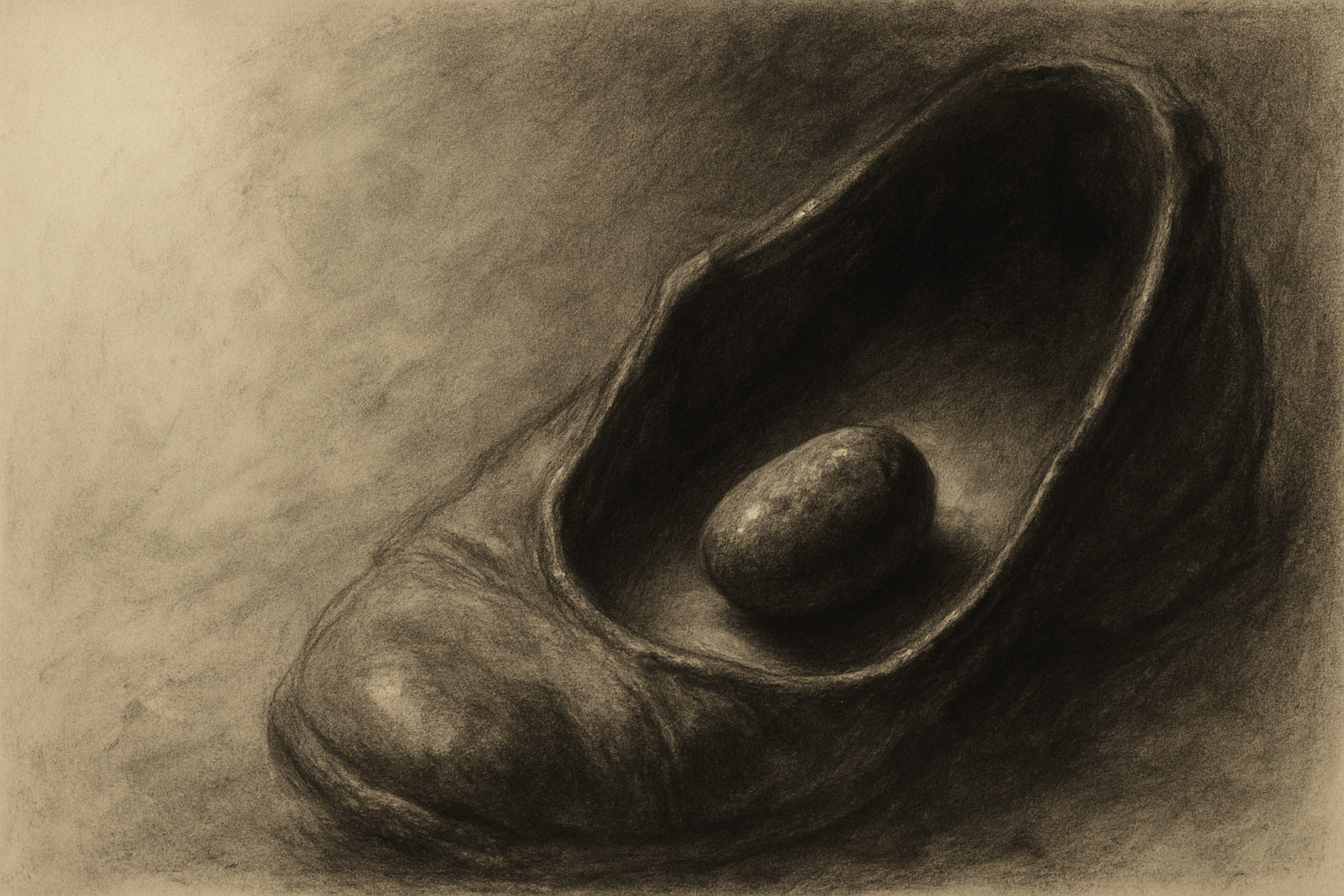
The Rock in the Shoe
La Piedra en el Zapato
A father asks how to sustain presence in the busyness of daily life. The dialogue turns from managing circumstances toward seeing through the belief that presence must be built, maintained, or recovered at all.
The Rock in the Shoe
A father asks how to sustain presence in the busyness of daily life. The dialogue turns from managing circumstances toward seeing through the belief that presence must be built, maintained, or recovered at all.
I haven't formulated a question yet, but I wanted to have fun. One question I seem to always have is that my life feels increasingly busy.
Welcome to fatherhood, I hear.
It's wild. And we're well supported. All in all, relatively speaking, things are pretty great. And still, I find myself wondering how to maintain a level of presence and energy.
It's the same question you asked me last time. Do you remember?
I don't remember the answer, but I do remember asking the question. I'm sure I've asked it multiple times, more than twice now.
So there's the fact of busyness. As you said, we have arms, we have legs, we have to feed the baby. There are some real limitations. It's in the same way that in the last question you talked about the mind state, or maybe the inertia, of depression.
Turning the question upside down
It's exactly about that. But you have to look. Sometimes going into the circumstances of life and what to do differently is the right approach, and I can go there when it feels right. For this question, and especially because you're asking it again, it reinforces my sense that this is just about the illusions.
You're asking how to preserve presence in a busy life. This makes sense, because there have been thousands of years of teachings and traditions built around finding, building, and creating presence. But the way I feel like approaching this is to flip it upside down. What is needed is to see that presence already is. There is only presence. All that can be done is to ignore it and enter the illusion that there is no presence. Then it will feel like it's lost, and then it will feel like it is recreated, rebuilt, and maintained. But it is simply realizing that presence was already here, always was, and always will be.
So how are you creating and choosing the illusion that there is no presence here? You have the experience of presence coming and going. What I'm pointing at is the illusion that creates the experience of presence going, being gone, and then something being done for it to come back. Presence never leaves. There is only presence. In fact, the only thing there is, is presence, which has been called the present. Everything else is the illusion that there is something other than this.
I think maybe it comes down to a belief.
Look at the need within the experience of presence coming and going. There is going to be a longing, a need, a desire, an attachment. Another way to put it: why does it matter for presence to be here, or to come back? You need to have the illusion of presence going away in order for you to then experience presence coming back.
Are you suggesting there's a need involved in presence going away and a need involved in presence coming back?
It's the same need. It's a desire, and in a sense it's a choice.
The way I tend to experience it these days is that I start my day relatively rested and fresh, and I feel a need to do things, to get tasks out of the way, personal tasks, work tasks. And there's a part of me that even enjoys diving into a project.
Yes. And what does that have to do with presence?
I tend to feel that I am somewhat present at the beginning of those activities.
What are you calling being present?
I guess it's a form of productive presence. It's not like being on the meditation cushion, or spending hours staring at a tree. So it doesn't feel like a super open, wakeful, blissful state of presence.
Presence is this
Okay, but now we're talking. Now I'm hearing a description of an experience: bliss, super openness. So there is a mental map, a qualifier, a condition for what presence is. Now I have news for you: presence is this. It is whatever is happening now. If what's happening now is a lot of thoughts and physical pain and discomfort, and I am aware that this is what's happening now, then there is presence.
But if I'm calling presence a certain change of state, where I feel more blissful or expansive, then I am conditioning and choosing what my mind believes presence should be. I create an object of thought, which is the experience of presence that I can chase. And I also create the object of thought which is the missing presence, now gone. So it's just an attachment to an experience. It's your drug.
There's a value judgment created by the self.
Yes, it's the egoic pursuit of a spiritual experience. Presence, in a sense, is the willingness to drop the belief in things being any particular way. It is being with what is, and that is presence. Ultimately it is the dropping of the fundamental belief in being Alex, in mind itself, in separation itself. Then there is only this. There is only presence.
That's a shortcut, but whenever you have a sense that you're not present, that presence is gone, recognize that as a thought. Whatever is happening now is what's happening, and that's presence, with all of the apparent failings of your current experience: my shoulder is supposed to not hurt, my mind is supposed to be calmer, the bliss is supposed to be here. That's all thoughts. Presence is exactly what's happening: the shoulder hurting, the mind rushing.
But it matters to notice that when one notices, "Oh, that's just what's happening," there isn't an engaging in the belief that it needs to be different. Paradoxically, that is tasted more and more as presence, and can be tasted more and more by those around you. Not because you're achieving a state, but because you are allowing whatever is to be what is, not wanting it to be otherwise, not chasing a state, which is always a mind state.
Right now I'm trying to feel around what I think is a paradox.
The experience of paradox is thought, so just let the paradox be. If you try to resolve a paradox, it's an infinite mind labyrinth. The paradox appears in thought, is created by thought, and then there is a new toy: let's solve this paradox through more thinking. And I know you love the toys of thought.
I can see you becoming immersed in that journey, which is beautiful, but I'm presenting a different alternative: just notice, right now, what's happening. There are thoughts, the experience of a paradox, the experience of wanting to solve it. All of that is thoughts, emotions, sensations. There are sounds, thoughts, sensations, colors, shapes, forms. All of it happening now, nothing more, nothing less.
When you're feeding the baby, there is feeding the baby. When there's the sense of "I'm not present now because I'm doing all this activity, and I feel what I call not-presence," all of that is happening. All it is, is sensations, thoughts, colors, shapes, forms, sounds. All presence. All happening within, and made of, presence. Even thoughts themselves. Even the belief and experience of separation, happening within and made of presence.
All is Buddha nature
As they say in the Far East, all is Buddha nature. What does the word Buddha mean?
I believe awakening.
Yes, awake, wakefulness. So Buddha nature means the nature of all of this is wakefulness itself. Thoughts are wakefulness. Beliefs are wakefulness. Illusions are wakefulness. Attractions, fears, pains, all wakefulness.
I heard a story that the Buddha had back pain, and that his quest to work with it eventually turned into Thai massage. I don't know if it's true or not.
I'd be surprised, but it's an interesting story. It could be.
I also heard a story a Buddhist teacher told about someone hiking with a rock in their shoe. He wondered, "Should I just be with the sensation of the rock in my shoe?" And the teacher said, "You can, but you may as well just take it out." I understand the premise, and I felt it just now with your guidance. My suspicion is that just practicing being with is its own thing. Just do that, and everything else will unfold.
What practice is for
Yes and no, because practice is needed, but it's not actually fully needed. I'm not even very convinced it's useful, and it's not sufficient, because practice is about something being repeated in order to get somewhere. It helps, but the practice of what? If what you're practicing is trying to control and maintain a mental, emotional, psychic, or spiritual state, that will never bring freedom. And what I'm calling freedom is whatever you most deeply want.
But if practice is clearing enough of the turmoil of my current experience, sufficiently, so that I can look more closely at the reality of what is here, asking "What am I? What is this?", that is different. Not because I want to create a state that I can arrive at and make permanent.
The former speaks to me.
You don't need to be doing anything, or not doing anything, for that. To call it practice, just look at experience closely, at any moment, whatever is happening. So don't think practice is sitting or walking or whatever thing you call a practice.
I've had experiences in many different kinds of activities, coding included, where I feel Buddha nature. And again, I understand that chasing that is the problem.
Yes, because what happens is that you notice something, and it becomes misinterpreted. You taste the real, and then the mind goes, "Oh, that's so good. I want more. What is it? How do I make it happen?" So when you said "I feel Buddha nature," it becomes a particular feeling. But I believe you have tasted the thing, and then it gets chased. This happens everywhere, in all activities that are loved and pursued. One can become great at athletic performance, artistic expression, any profession, medicine, whatever. When one is in that flow, what is tasted is Buddha nature.
But then the mind interprets that as conditioned by the experience: conditioned by the athletic performance, the flow of the profession, even by sitting and meditating. So what can be learned is, "I now have a way to taste this." The more I can taste it without that condition, the better. If I can only taste it jumping off an airplane, that's a very conditioned way. It has to be quite extreme before the belief in separation stops. Or it happens only when I'm really enjoying my hobby.
But at some point it needs to come further. The more we can recognize reality and truth, the more it can be tasted even in doing nothing. This is what has been called meditation: sitting, doing nothing. But it can also be washing dishes. Then it becomes a bit of a challenge: how is it that I believe this is gone? "I don't experience it when I'm fighting with a partner. I don't experience it in a challenging work situation. I don't experience it when I'm doing something I don't like." Those are the beliefs. Those are the illusions. And more and more, I start to have no experience where presence is not known. It becomes tasted as: all is Buddha nature.
The storm as peace
It's not a feeling. It's all feelings, all sensations, all thoughts. This was part of one of my most shocking realizations. I had many years, decades, of practice: calming the mind, looking at thoughts. Everything seemed to say the thoughts were the problem. And then, not as a thought, not as a glimpse, but as direct experience, I realized that all the storm and thinking was as peaceful as a no-mind state. The experience of the storm of mental emotion, of physical distress, was as deliciously peaceful as the absence of it. It was very hard to believe. It was almost the opposite belief: "No, this cannot be. I cannot be experiencing what I'm experiencing. It makes no sense."
So you had the experience of a mental storm without feeling present, without the qualities of presence?
Exactly. There was just the same freedom, peace, and well-being. It does not have content. There isn't a feeling. Freedom is not a feeling. Peace is not a feeling.
But prior to that realization, you'd had experiences of mental chatter, of feeling distracted, of not having control of your mind?
Prior to that, I had already been in a pretty much unbroken peace for several months, everything, everywhere. But I also hadn't had a stormy mind for many months. So there was still a belief that this was associated with a calm mind. Then I had that question, and I explored it. What if I moved in a direction where a stormy mind arose? It did. And I realized: it makes absolutely no change. The storm itself is peace.
When you're not identified with it.
Yes, of course something had changed. The difference is that it wasn't that I was able to not believe the thoughts. The believing ability itself had stopped. I lost the ability to believe thoughts. So when the storminess came back as an experiment, it was like watching a movie. Absolutely no effect. There was only the peace that had always been here, but that I had discovered anew, directly, many months before. It took me a few months even to understand what had changed. It took months even to have a name for it. I was calling it silence at first.
Naming the peace
There were a lot of sounds, a lot of thoughts still happening. I didn't have a thought storm, but thoughts were happening, and I was calling it silence. I hadn't heard that word used for it anywhere, but it was the word that came. I was walking back and forth in my apartment, completely immersed in that experience, curious: what is this? What happened? Where did this come from?
I started to put words to it. It was like a silence, but it wasn't, because there were sounds and thoughts. It was like a calmness, but a calmness I could not grasp. There was no way I could touch it, think of it, or understand it. It was a peace I couldn't grasp with thought, a peace I couldn't understand. And then the phrase from the Bible hit me: the peace that passes understanding. For weeks I asked, "Is that what this is?" It took a long time even to grasp it cognitively. But what was known is that this was always here.
And yet it sounds like there was a lengthy process of months.
It was only about being too occupied with how to name it. What I realize now is that it was, in a sense, prior to and beyond thought, beyond the mind, so the mind was completely unable to name it or put any meaning to it. In hindsight, another sense arose: why hasn't anybody talked about this? Why didn't my teacher, whom I'd spent twenty years listening to, talk about this? It's so obvious. It's so mind-blowing. Then I went back to the recordings, and he was talking about it all the time. I just couldn't hear it. The words he was using had made no sense.
So you're saying that without the traditional tools, cultivating samadhi, going on retreat, formal meditation, this kind of realization is possible in any activity I'm engaged in? Just being with is possible?
Prior to doing
Yes, and even the language you're using is all about doing. So I'm trying to get you to see there's something prior to doing. "Being with," to me, sounds like an activity. Right now, you're hearing the sound of my voice, having the experience of sensations, the knowing of thought. Are you doing anything for any of this to happen, for any of this experience to be known? Do you have to do something for the sound to be known? Do you have to do anything for sensations to be known? What effort is needed to hear?
I think I just stopped.
No, not even that. What can you stop doing for sounds to be known? You can't even try to not know sound. Do all the effort you can to not hear the sound of my voice. Do all the effort you can to not have the knowing of sensation. Prove to yourself that you cannot do it.
I was able to tune out the meaning by playing a song in my head.
The meaning, yes, but you're still hearing. All you're doing is changing the content of thought, from the meaning of words to the sound of a song. It's all imagination, all thought. When a thought is appearing, in the moment it appears, can you do something to not experience it?
No.
So what is this doing and efforting we're talking about?
Maybe I have a belief that I need to think in order to feed myself, to feed my baby, to earn income, to keep the house in order, to keep my relationship.
I know there's a very basic level where that's actually true.
I'm aware that it's a belief, but also.
Locating the belief
But what's the belief? Tell me the belief very specifically. Describe it precisely. And be very careful when you say the word "I." What are you referring to?
This sack of meat and flesh. Can I tell you where I think I'm going wrong?
Sure, let's go there.
At a fundamental level, I don't currently have a death wish. And if I did, maybe this would all be fine, and I could identify with global consciousness and let my body perish.
You cannot identify with global consciousness. There's no such thing, no such possibility or ability. It's not possible.
Perhaps my corner of global consciousness that is not dependent on my physical body.
That's an idea. That's just thought. Thought is imagining something called global consciousness that you can identify with, instead of thoughts about Alex. It's just more thoughts. You can realize you're not that, and you will realize you are that which cannot be named, which has been named consciousness. You cannot identify with it. You can only realize what you are. That identification is always illusion, always a false belief.
To know what you are, in the sense of recognizing "I am," is the end of knowing, the end of being able to say what I am, the end of calling myself something. The mind is going to interpret it as, "Oh, I think I'm Nicholas, and I'm going to realize I'm something else, and that will be self-realization." No. It's the end of having something that is what I am. To the mind, that's nonsense.
It's funny, because I keep trying to set up a story. I keep trying to complete the articulation of what I think is going on, but you interrupt me.
From the very beginning, exactly. Because if we spend twenty minutes hearing a story of illusions, we could just snip it at the bud.
Could I make it a little further in my story?
Sure, my meeting got canceled, so I have a few more minutes.
So that what you're bringing up now can be brought to bear on the middle or the end of the story?
Yes, there's value in that. Go for it.
The full to-do list
I want, whatever that means, to continue living in this body for a while. And I have a belief that in order to do that, there are some basic things I need to do. Sleep, eat: those are the most fundamental. Where I'm getting a little lost is that I find myself sometimes in a bit of a trance, moving up that ladder, to the point where it's very late at night and I'm researching non-toxic, nonstick pans large enough to cook the meals my wife wants to make. That's just one tiny example of the stuff that's made it onto this ridiculously full-featured to-do list app I found, which my brain loves. The part of me that wants to optimize has an Eisenhower matrix and all kinds of things. But sometimes I wonder: how did I get here? What belief has me unconsciously moving from "I need some basics" to "how to optimize my career trajectory" to "what are the best non-toxic clothes I can buy"?
Can we pause there? There are a few angles to what you just shared. One is: how are you so sure that everything you're doing is wrong? What's the problem with being up late at night? There's an assumption and a judgment that if you were more awake, you'd be doing things differently. How are you so sure that researching for three hours obsessively at 2 a.m. for the nonstick pans isn't the most beautiful, loving thing you could be doing for your family? And not just that, how are you so sure it isn't the thing you love to be doing most in that moment? To be obsessed as a dad about getting the perfect thing for your wife to make the most beautiful meals for your baby is super loving. How do you know that's not it?
I have two answers. One relates to that background dissatisfaction I've heard you talk about before. I notice its presence. The other is that it has a little of an addictive, gone-too-far quality.
For sure. That's why I called it obsessive. But that can be personality, and it could be in service of love, and it could be totally free. It's possible for that to be the truest, most authentic, awake form of being, with the quality of focus, even hyper-focus, even a slightly obsessive nature. The sense that it should be different, that it's wrong, is believing that the dissatisfaction is caused by it. But the origin of the background dissatisfaction is not in what's happening and what you're doing.
Not caused by it, but a distraction from looking into it?
Sure, we can say you're avoiding the dissatisfaction and therefore obsessing. That's possible. But there is an illusion that I can then change the behavior, and that will fix the dissatisfaction, right?
Yes.
Exactly, and that's a belief. It's the other way around. Just let the behavior be. Observe it, note it, don't judge it. You cannot know. Then be curious about the dissatisfaction, and notice that it is going to be there pretty much all the time, no matter what you're doing. The dissatisfaction only comes and goes to the degree that you believe something that's not real. The only way to be free from it is to stop believing the things you believe, especially the beliefs about Alex: about what you are, what I am, what Alex is, what Alex needs.
The stone in the shoe
I'm about to say this, and I don't mean it sarcastically. It's like the belief about feeling the rock in my shoe. There's the pain of the rock, but then the belief is the second arrow. The same could be said for walking on hot coals. There's a sensation, but the belief about what that means is its own thing. Maybe not a good example, but separating the two.
So you're walking with a stone in your shoe, metaphorically. It's not pleasant. You then start to associate not being okay with the sensation of the stone in your shoe. You will only be okay when the stone is no longer there. So you remove it. But now the belief in not being okay has to do with the little crease in your sock. Only when that sensation stops will you be okay. So you uncrease the sock, and then there's still a sense of something not being okay, and now it has to do with the sun being too bright. Only when you get sunglasses will you be okay. So you get sunglasses, and on and on and on.
Then the sense is: once I get all of these variables perfectly okay. Because once in a while I do feel okay. When I take the stone out of my shoe, I feel great for about a second and a half. And then the sense, the need, that something's not okay is back, and it's not the stone anymore, it's something else. What I'm pointing out is that all of that doing, all of that practicing to get the perfect stones, the perfect shoes, to remove all the stones, to make your thoughts and sensations be in the right place, is never going to ultimately help. What helps is to look directly at the sense that something's not okay, something's missing.
Then what the mind does is say, "Well, if I do that, I'm always going to be walking with a rock in my shoe, because I have to accept that whatever's happening is okay." No. Suddenly you don't believe you're fundamentally not okay, but you can still take the rock out of your shoe.
Living with the rock
It's funny, because what you just said fixed something for me from the very beginning. The thing I was having trouble getting was the belief that I would have to, metaphorically, just live with the rock in my shoe.
Exactly, that's what I mean. That's exactly what I'm saying. It's the belief that if you allow what is to be what is, and to be beautiful, and realize that the dissatisfaction is the belief that things are fundamentally not okay and need to be different, then that requires you to let things always be unpleasant and do nothing about it. The difference is much simpler. There's a rock in my shoe, and there's a fear that I'm not okay, that without the rock gone this reality is fundamentally not okay. It could be intense or subtle, but it's this sense that something's missing, and the sense that it must be the rock in my shoe. There is a fear-based relationship to the experience of the rock: a restlessness, a worry about where things will go.
All of that can go, and the rock in the shoe remains, which is uncomfortable, and now there can be peace, a recognition that you're completely, absolutely fine even with a rock in your shoe. Nothing is missing. But there can still be a love for all kinds of forms of living and experiencing, which can be, "Hey, let's remove the rock from the shoe. Let's get new shoes that are more comfortable. Let's get a beautiful, perfect nonstick pan for my wife to cook with." Not because I'm worried things are not okay and everything's going to fall apart, but because it's beautiful.
And maybe you can realize, "Now that the worry and the fear relationship with what is is gone, I don't think I need the pan. It doesn't feel important anymore." Things can change, but not the other way around. You want to uproot the illusion first, and then you will see: does it matter that you have a rock in your shoe? It's so small that most of the time I don't feel it, and I'll take it out ten minutes from now. Sometimes it's like, "Oh my God, I've been unnecessarily walking on prickly ground with my shoes in my hand. Maybe I should stop and put them on."
Something you said reminded me of a Seinfeld episode, with a character proselytizing a method of beauty from the outside in. I won't try to re-describe it, but thinking about it makes me realize the silliness of identifying the discomfort of the moment and thinking that fixing it is ultimate freedom.
Which doesn't mean ultimate freedom isn't also fixing the little things of the day. It's just that fixing the little things is not going to get you there. Freedom doesn't mean you can't do anything about anything. You just have the clarity to see what matters, what's important, what frictions are relevant, what things are beautiful and loving to do, not coming out of this desperate sense that something's missing, dissatisfaction, frustration, and friction with every little thing.
Facing the unknown
Just listen to the recording. I think you'll get something out of hearing all of this again a few times. I've never suggested this before, but I'm recommending it, because there are a lot of little tricks and traps in your thinking. Just hearing it will help you see all the little traps and beliefs. It's just the beliefs.
The experience of it is ultimately a fear, though it might not be recognized immediately as fear. It's like the dropping into not-knowing: what's going to happen? If I don't hold on to all my little techniques and strategies for making life and myself okay, are things just going to get worse? What happens is a fine line to tread, because at first things may appear to get worse, since we'll start to get in touch with fears and pains we've been avoiding.
Once we start making those sensations of fear and pain something I can taste, rather than something I need to avoid, there's a bit of a crossing to the other side, where being in that not-knowing, being in the unknown, is more and more tasted as the freedom I've been looking for. That doesn't mean I can no longer move and live and do the things that are seen as most valuable and important.
In the simplest way, it can be said that we start to live from freedom and love, and not from fear, by facing the biggest fear we have: the fear of ending, the fear of death, the fear of pain. This unknown, this sense of not knowing what I am, not knowing what's going to happen, is experienced as an ending, as a death. But it's just an experience. It's not a real ending.
I do have to go. Thank you all for joining, and thank you for your question. I'll see you next time.