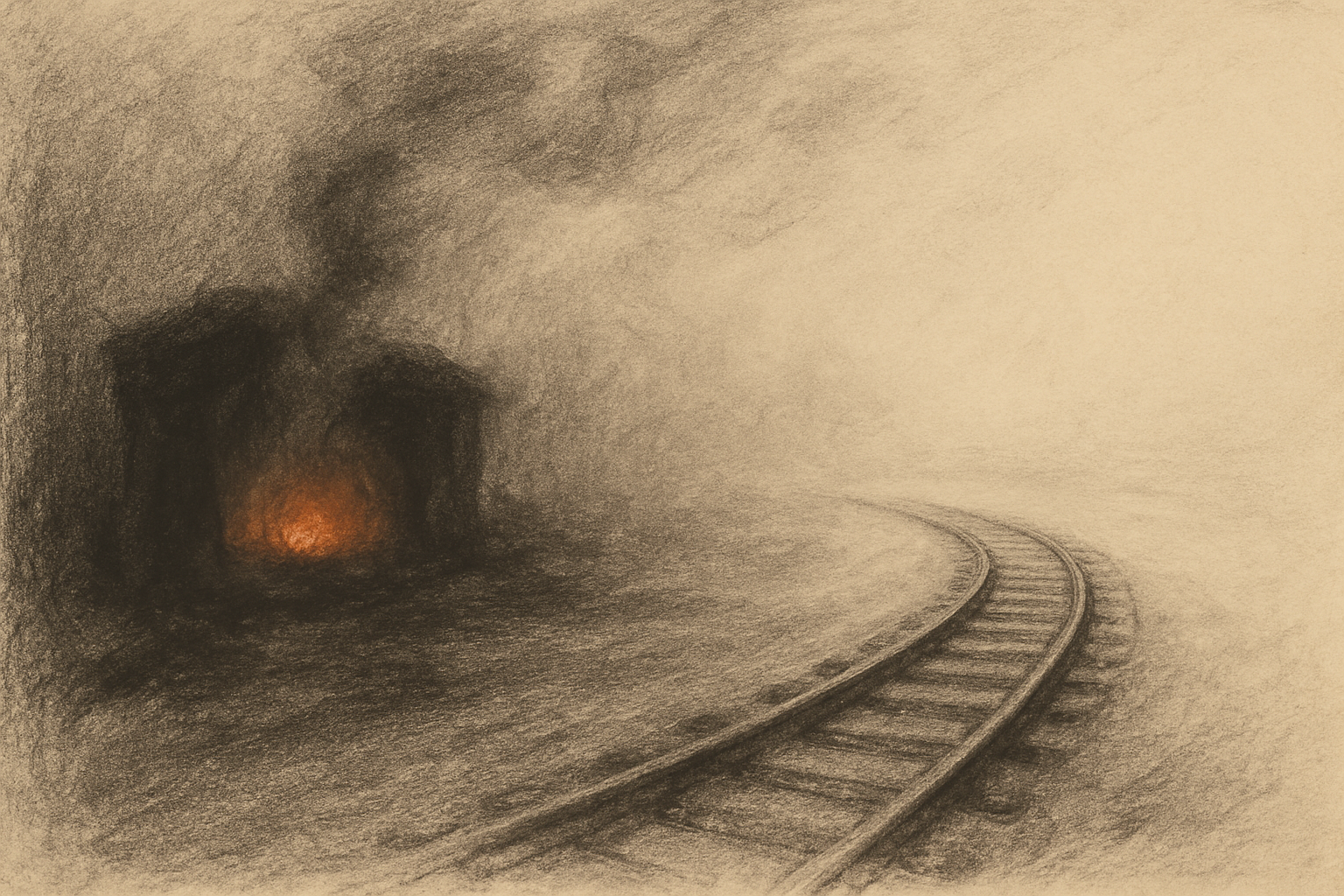
The Furnace and the Train
El Horno y el Tren
A conversation about why calmness cannot be pursued directly, how the nervous system settles only as an after-effect of recognition, and why the real work happens at the level of identification and the heart.
The Furnace and the Train
A conversation about why calmness cannot be pursued directly, how the nervous system settles only as an after-effect of recognition, and why the real work happens at the level of identification and the heart.
I could become calm in brief moments and notice some of the things you were mentioning, but overall it was very difficult to be in a calm nervous system. Which I suppose is itself a good observation.
Specifically noticing the moments when you do recognize what I was talking about: that really matters, even if it lasts a microsecond. It is very significant. It is the most important thing. The rest is just that recognition becoming more and more obvious, because it is always present. But at first, what matters is only that microsecond of resonance. Then you will find that even when you are not calm, you still notice what I am talking about.
That kind of nervous system calmness is an after-effect. Think of an engine that is burning, rushing forward. Then suddenly, or slowly over time, what powers it begins to shut down. But the nervous system remains in a state of activation, keeping its momentum even after the engine is off. So it matters to recognize this first. Instead of putting attention on the effect, instead of seeking the calmness of the nervous system, let the calmness come as an after-effect. There will still be moments in life that are more stressful, natural stressors, but that quietness of the recognition of being and knowing can be there no matter what is happening.
That sounds rather sublime.
It is, but it is also quite ordinary. It is something natural to what we are. It simply takes time to recognize, usually. In some cases it does not, but it is more common that it takes time.
The trap of calmness as a goal
I did notice the ongoing identification with the thought stream. At one point you mentioned awareness joining with it, or something along those lines. So you said the nervous system calming is an after-effect. I did notice a contrast between attention being fairly focused on one aspect of the body versus something wider. I suppose the point is: do these kinds of practices, and calmness will come.
Yes. The purpose of the practice, if we want to call it that, is to recognize what is already here, the nature of what is here. Otherwise practice can become mapped into thought as a thing we will do over time to reach calmness, and then calmness becomes the objective again. Instead of looking at what is powering the restlessness, which is an illusion happening right now, we push against it.
If you are on a train rushing forward, full of energy, full of a burning furnace, and you do a practice to slow it down, you are pushing against its own power. If practice becomes the thing we do in order to calm the nervous system, to stop this engine, it is not as effective. That can take many years. Eventually it is recognized that what actually slows the train down is stopping the furnace, turning the power off. Then it runs for another while, and it might start all over again, but we learn not to spend energy pushing against it.
The illusion is what is happening now. The illusion is that the calmness you want is not present. That is the illusion. So what you are looking for becomes something that can only be found in time, only when your body settles, which it is not doing now, so it will have to be tomorrow. And where does tomorrow exist? In thought. The calmness now exists as the imagination of a possible future, so your focus is in thought. Now you are trying to calm the nervous system, which is activating through thought, by thinking, by putting energy into thought, which is the very thing fueling the activation.
On one hand it is confronting to hear, but I can also see it is the case.
It has happened to all of us many times. A core point of these meetings is that through these conversations, and more specifically through the meditation, where there is time for you to contemplate what is happening with some guided direction, there can be these micro-glimpses, micro-tastes. At first they are partial. There is a sense of, "Yes, that resonates, I recognize that is here." It is no longer an interpretation of something spoken about; it is in your direct experience, even if only for a microsecond. Over time that recognition can become more complete, more and more obviously always here.
Recognition as absence
I am speaking of it as a positive, but it could also be spoken of as a negative, since these are just styles of speaking. I can say that what is recognized is the absence of something, and there is a calmness and peacefulness in that absence.
One approach has to do with identification. I first believe myself to be the body, and in consequence the imagination of what the body is: a person. In that imagination there is a narrative of past and future. There is a very sticky sense that what I am is a particular someone. But one hundred percent of that someone is imagination.
So you tie that to identification with the body. Are you saying the body and the mind are one identification?
Yes, because it becomes an extrapolation. The evidence that I am the character I am imagining is the body. But there can be the experience of body without the imagination of the character.
How is the texture of that different from the identified version?
There is body, and there is no character. The character appears in this imaginary form, and when it appears, it is seen to be imagination. Therefore what I am is not that. I am pointing at the fact that an aspect of this is a certain absence.
When there are these moments of tasting calmness, it actually has to do with a separation from this identification, a momentary dropping of it. The character, the narrative, is in distress. But if I am not the character, if for a microsecond I recognize that the character is known, that it comes and goes in imagination while the knowingness and beingness is here, prior to the character, then the character comes and goes, and the distress comes and goes with it. Those micro-moments of disidentification are known as a settling, a restfulness, a freedom, a spaciousness. Like the wind going out of the sails of trying to figure something out. There is a very positive effect, a release.
I address it as both positive and negative. I can talk about it as recognizing something that is here, this peace. But the peace is also here as the absence of something: the absence of the illusion of being what you are not. When I believe I am what I am not, there is stress, a nervous system fueled by more and more distress in a loop. In the moments of recognizing "I am not that," there is something else here that I am. This can be a gentle, gradual seeing, more and more deeply and clearly: what I am is still not clear, but I am not that. In that process, over time, the energy fueling the distress begins to slow down. But not by trying to calm the nervous system. That only adds fuel, because it is an objective to reach somewhere in time, more imagination, more thinking.
Attachment to the illusion
It really brings me inward in a way that does not want to.
There is an attachment to the illusion. When that is confronted, it is confronting both to the illusion and to the part of us that is very attached to it. This is why it often happens over time. It is an inner negotiation: "I really like my illusion. How much can I hold on to it? Yes, it is stressful and it is killing me, but I still like it." Until it becomes too much and I give it up for a bit, then go back to it. There is this dance.
For some people the distress was so total that the illusion simply dropped completely, but that is rarer. More often it is this back and forth between the attachment to what is illusory and what is reality. Reality is very confronting. It is rare to find someone who is free of illusion, and rare because it is not fun. The ending of illusion is very unpleasant, as liberating as it is. We humans, myself included, will do anything possible before dropping an illusion. Everything else has to fail first. Or you are lucky, with good karma, and they drop just like that. That was not my experience.
Going into the sensations
What is your experience with a more somatic approach, providing space for yourself? A moment ago there was a deeply wounded version of me, and I really felt I needed to allow space for it, because of how confronting it was. I suppose that falls into the category of somatic practice.
Everything somatic is a very good direction. My own experience, briefly, was a decades-long process of this back and forth, with a great deal of physical and emotional pain, very distressing, where everything failed. Then a deep surrender happened. Since then, whenever something challenging comes up, it is very straightforward: there is simply the going into the sensations. The sensations are always what is hardest.
All of our attachment to illusion has one purpose: numbing and avoiding sensation. We can describe the dance abstractly, as what is true versus what is not, but it is really about, "Can I avoid a thing I do not want to feel?" If so, I will, and what is required for that is illusion. Over time we learn that it really does not work. It is not good in any single way. That is the surrender. Then sensation, even pain, becomes full of life and beauty and love, when there is no longer the need to avoid. That has been called transmutation, but it is a change in the relationship, a very fundamental change in what something appears to be.
What actually changes in transmutation
Before I had direct experience, I read a lot about transmutation and interpreted it to mean the thing itself changed, that some lower vibrational feeling got transmuted into a higher one. My more direct experience, more often, is that the nature of what is there does not change; it gets recognized more clearly. For example, there is a pain in the heart, a pain with a very unpleasant, unwanted taste. Through a shift in the illusion, that same pain, the same energy with the same flavor, changes into something very alive and beautiful and loving. I could call it transmutation, but what changed is not the energy or the pain itself. What changed is that it had been known through a veil, through an illusion, an unwanted veil of "this is not pleasant, I do not want this." When that veil drops, the direct relationship with it is recognized: this is love, this is beautiful. The resistance had tainted it as unpleasant.
At the core, this is at the heart level, the level of love. The deepest sense of what you truly love and want in this life, soul-level desiring. I cut right to the point, because otherwise it can stay abstract, but if it is not addressed at that level, it will not resolve.
Accepting love
So the term "accepting love" points to that.
Yes. That term came spontaneously out of recognizing that the love I was looking for is already here. There was a resistance to it, but also a need to accept what it implies. When it is missing, I can live a life of illusion in which I am lacking, and in a sense a victim of what is happening. But in the recognition that what I am looking for is not lacking, that in fact it is abundant, there is an implication of responsibility. There is a complete change in how to live, not spontaneously, but demanded by that reality.
Waking up and growing up
This is why I talk about the distinction between waking up and growing up. Much of what we spoke about earlier is about waking up: the ending of the illusions of what we are, seeing through them, and the recognition of what is already here. Growing up is what that recognition implies, and how to live with that truth. These are intertwined, but growing up happens in time, while waking up happens out of time.
Is growing up another word for integration?
Yes, but it can also happen before recognition. Integration usually refers to integrating a realization, some level of awakening. Growing up is wider; it can even be the preparation for the recognition. In many traditions this was always a requirement. Before awakening practices, there were growing practices, very commonly. The more direct awakening practices came later in the process, because there was an understanding that a fertile, healthy ground was needed in the body and mind, not only to make the recognition more likely, but also less problematic when it happens.
I can see that from my own experience over the past several months. I simply could not accept certain things. It was an accepting love, and I could not do that.
Thank you for the conversation.
You are very welcome. A pleasure to meet you.