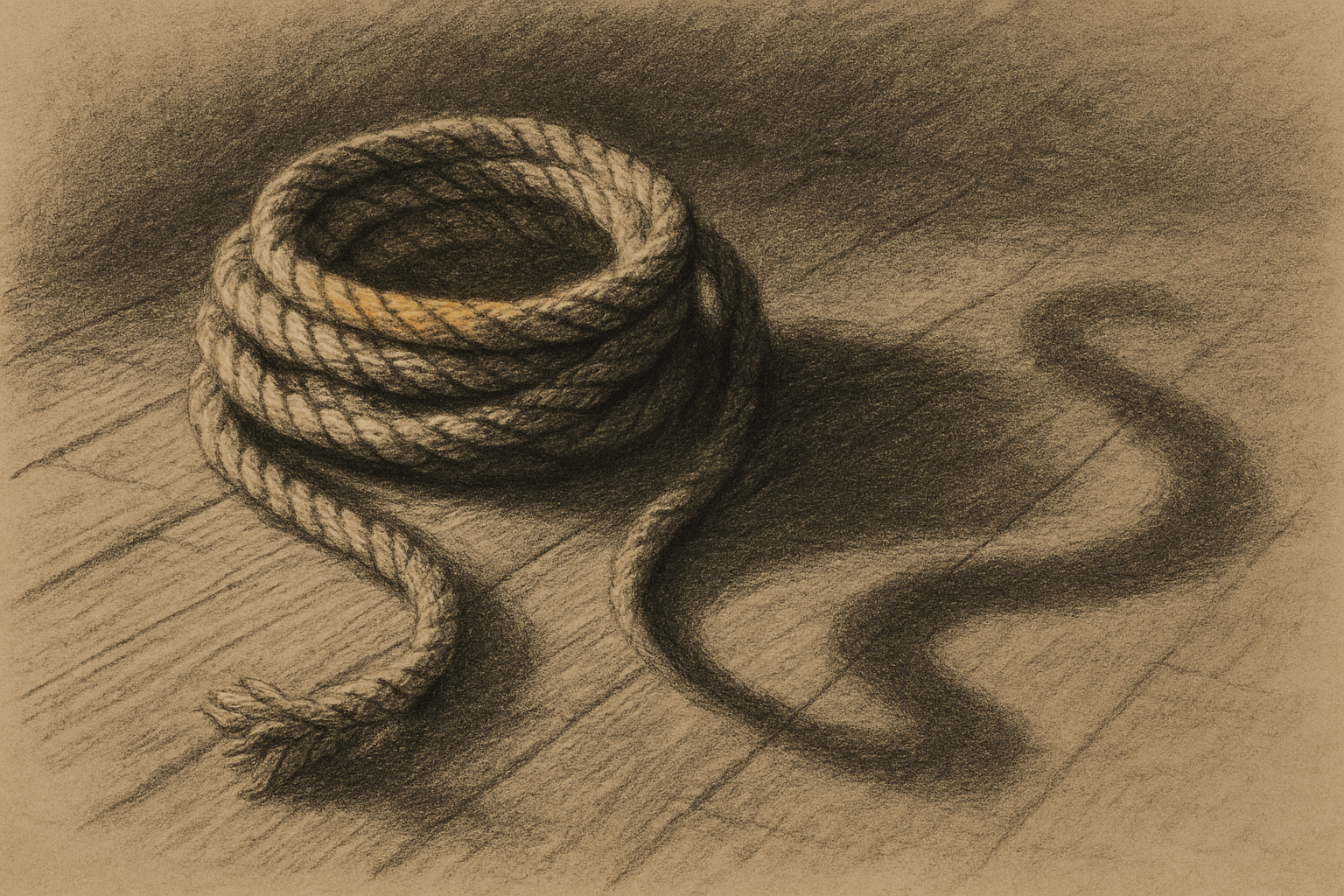
Rope and Snake
La cuerda y la serpiente
A student asks whether the basic dissatisfaction underlying experience, like the sense of identity, simply remains and is seen for what it is. The teacher distinguishes what is true from the method of pointing to it, and explores how the illusion of self relates to the avoidance of pain.
Rope and Snake
A student asks whether the basic dissatisfaction underlying experience, like the sense of identity, simply remains and is seen for what it is. The teacher distinguishes what is true from the method of pointing to it, and explores how the illusion of self relates to the avoidance of pain.
Can I ask a quick one? I want to build on what was said about the freedom in accepting that primary dissatisfaction. With the sense of identity, it's never about getting rid of it. It's just seeing it for what it is. Is it the same with that primary dis-ease, or whatever the right word is? It's about seeing it for what it is, not about dissolving it?
What is true and what is method
Yes, but there's a complexity in what you're bringing up. It implies the question of what we are talking about, what is real. But it also implies method: what is the right approach?
Or no approach at all.
There is always an approach. Your question combines two things: what is true, what is real, and also what the best approach is. When I hear you talk about the dis-ease, the lack of ease, and about identity, about the longing not needing to be satisfied and the identity not needing to go away, I hear both of those things mixed together.
I see what you mean.
Having satsang is a method. Having dialogue is a method. Talking about non-duality is a method. The method generally implies that through dialogue and communication, some understanding or shift can happen. Then there is a conversation about what that shift looks like. For example: does the shift look like "the dis-ease is still there, but it's no longer a problem"? That is a description of what the experience might be. But even having a conversation about it is method.
So my response will always include method, because what it really is cannot be spoken. Even describing it is method, because it's an attempt to communicate something that will be useful to you in some way.
The finger pointing at the moon?
Yes. I want to clarify that in trying to answer your question, I am attempting to describe something that cannot be described. That implies using a method, even if it's only a description. Even saying "it cannot be described" is method.
With all of that said, I can speak to it. Trying to undo identification is poor method. Trying to undo the dis-ease is poor method. That's why the answer "it's about just noticing it, seeing it" is also method. And yes, I think that's a better method. Do you follow?
Yes, I think so.
Words that cannot be defined
To say what it ultimately is about, I can use words that cannot be easily defined. That is the way it can be communicated, but you need to make sure you don't put too narrow a definition on the words. That part is up to you.
So it's about freedom, and it's about peace. But it's a peace that you cannot understand intellectually or conceptually. This is the peace that passeth understanding. The same goes for freedom: if you know what that freedom is, it's not that.
Yes.
The same with love. If you know what love is, it's not that. Or consciousness: it's the realization of consciousness, and if you know what consciousness is, it's not that.
So what does it look like? I can describe it, but however I describe it, it will be very hard for you to interpret and understand it as it actually is. That's because of the limits of communication, and because one cannot imagine something that is beyond the mind.
The ending that doesn't come by trying
So it actually is about the identification ending, and the dis-ease ending. But it doesn't end in the way one thinks it does. It doesn't end by trying to end it; that approach is often problematic. This is where the methods and practices evolved. One of them is satsang and dialogue. Another is sitting with yourself and looking. Those are different methods.
Ultimately it's about the ending of what in Buddhism is called dukkha, dissatisfaction. But it was also said that there is a method, a way. Otherwise, if all one hears is "there is dissatisfaction, and one can end it," then one will try to become satisfied by all possible means: "If I conquer all the kingdoms in the world, that will be the way to ultimate satisfaction." That's the misunderstanding. Satisfaction doesn't come that way. It comes through the ending of an illusion.
Rope and snake
Now, back to your question, more specifically about separation, identity, identification. One could say it remains. I would say it doesn't. What was there remains. Something doesn't change, and something does. The appearance of what seems to be a separate character remains, but it is no longer experienced or known as self.
Oh.
It's like the classic image of the rope and the snake. The rope was there before, and it's there after. It's just no longer known as a snake. But even that isn't a perfect metaphor, because one might think the snake simply disappears. So let me put it differently, as a small correction to the traditional version: before, there was a rope and a snake. After, there is a rope and a snake. But before, the snake was thought to be real. After, it is known to be an imaginary snake.
Oh.
Both rope and snake were known and perceived. Before, the snake was believed to be real, and the rope was seen as one with the snake. After, rope and snake are known as two aspects of experience. One is known as perception, the other as imagination.
So the illusion could be described as a kind of attachment?
"Attachment" makes it too sticky. It's very simple. It's just seeing the thing for what it is.
Yes. Maybe I should explain more. I heard someone talking about deeper realization, and how prior even to "I am" there is this sense of dissatisfaction, the seed of all of this. So my question was whether that remains too, but is simply seen for what it is.
No, I don't agree. The dissatisfaction ends.
Here again we are coming to method. I was talking about the rope and the snake and improving on it, giving it a little twist to clarify a point. But it's still a metaphor, and it still has problems. Let's put it in more context.
Before, there is a rope and a snake, but the focus is on the snake, and it is believed to be reality. The snake is projected onto the rope. So the rope is not known directly. It's there, it's being looked at, it's perceived, but it's overlooked. There is an overlay, which is the snake.
After, there is the recognition: "Oh, the appearance of the snake was in imagination, in mind. In perception, there is rope." And now the overlay is known as an overlay. It's perceptually obvious. It's like a magic trick: before you understand it, it's magic; after you understand it, you see the trick, and it's obvious. It's like an optical illusion. It appeared to be a snake, but the snake was imagined.
Then, over time, I don't see the snake. I see rope. The snake disappears, or it may still appear once in a while, but it's known to be imagined. It's no longer "snake, snake, snake" every time there's rope.
Sensation and imagination no longer taken as self
What before seemed to be self, which is sensation and imagination, is now known as sensation and imagination. The sensation is no longer known as self. There is no projection of self onto it. And the imagination of the character is a function. In a dialogue, there is an imagination of a character, a self in the normal sense, but there is a knowing that this is not self. Metaphorically, it's a little like talking about a movie.
Wow.
It's not really like that, but it's a little like that, in the sense that it's known not to be completely real. And that is the part that cannot be put into words: how is it known, how does it appear, what is the experience of it? It cannot be described, and it cannot be imagined. It can only be recognized in your own experience.
But these discussions can help something seep through. Some illusion gets recognized, and you see, "Oh, that was thought." Then there is, in a sense, a movement in you, an instinct for seeing reality, that naturally moves on its own. These conversations tend to support that.
Why trying not to see the snake fails
Suppose you see a snake, and I tell you the snake isn't real. Then you try not to see the snake. The more you try not to see it, the more you imagine it. That's where method matters: that approach just isn't going to work.
Well, it can. Any method can. Some Zen teachers are famous for just whacking you over the head. That's method too. Anything can work; there are infinite creative ways of teaching. And for me here, it's evolving. I'm exploring and learning. But I find it helpful to clarify that this is about reality versus the illusion of what reality is. And that is very tightly related to interpretation in mind, in imagination.
Yes. Like any thought, really.
Yes. And to see that much more of what you experience as real is thought than you notice at any moment. That's a bit of a rabbit hole, how deep it goes. "Oh, that was thought too. Oh, that was thought too. Oh, that was thought too."
I sense it gets very subtle.
The illusion in service of avoiding pain
Then there's the question of why: what is it for, what is it in service of? This is the other side, the side of growing up, and it has to do with the illusion. The illusion is in service of avoiding association with pain. It begins with a misinterpretation of what pain is. Misunderstandings and ideas about pain create ideas and misinterpretations about oneself, about the nature of what we are.
We can discover that much of our turmoil is the avoidance of pain, or fear, which is also the avoidance of pain. Fear is always fear of what? Of pain, some form of pain.
Imagine you realized that the whole universe of pain one can know and experience was, for you, like getting into a hot bath: you're fine, it's delightful. All the pain that is imaginable, all that is possible. Would there be fear? Would there be any need for strategies of avoidance?
No, there'd be no need.
It sounds a bit extreme, but it's possible to know this about the vast majority of what counts as normal pain in ordinary life. I'm not talking about torture, but the vast majority of it, including death, because there is a way in which death can be experienced. Then comes the realization: whatever sensation or energy with painful qualities I fear and avoid, whenever it appears, what this is, what I am, what is here, is completely fine.
Yes.
What I'm describing now and what I was saying earlier about the illusion of what I am are the same. They're deeply interrelated, because the illusion is a form of avoiding that sensation. If one no longer needs to avoid the sensations and energies that were being avoided, if they just come and go like a hot bath, then the whole illusion has no point.
And the dissatisfaction, the dukkha, the dis-ease you're referring to, is this constant need, imagined or believed, that says: "I'm not okay with that. I won't be okay. So I need to control, and I need to avoid."
Origins versus what is happening now
There's a curiosity about how it first arises. We've been talking about it, but I sense it's totally ungraspable: the very first point where the illusion begins.
It's happening in any moment when it happens. It's not in time. It's right now.
I guess I mean in childhood, when you're very young.
That's philosophy. We could talk about it, and we could get a little academic.
Yes, academic. I know that's what it is.
It could be interesting. It could satisfy some mental curiosity. But the point is how it's happening, the process of it happening right now.
As I said, it's just a curiosity. But it's interesting.
Yes, but the mind goes there because it thinks, "If I understand its origin, I'll be able to resolve it." And that's just more of the loop.
You got me.
With philosophically inclined, curious people, I can have those conversations. But here, in this moment, I have a responsibility to practice a method, to serve what you're here for. So I need to be clear that this direction is academic or philosophical, and most likely not going to lead you anywhere.
So you don't want to talk about hedge cutting, or making the bed?
The divinity of making the bed
No, that's actually far more valuable, because it's about what needs to be done in any moment, and about attention and presence. Hedge cutting and making the bed are the most spiritual things there are. Your hedge cutting, your bed making, are divine, when they are seen for what they are: divine creation, right now. Nothing is more divine than making the bed when one is making the bed.
It's not that I must go off to divinity and then come back to make the bed. That's religion: making the temple more sacred. Of course, temples are beautiful places for celebration, for creating a space that invites the divine. But is the temple more divine than the bed, the home, or the forest? Is there more presence of God there? No.
At any moment, whatever is happening, that's where God is. If God is elsewhere, that's illusion, that's confusion.
But if I say that wherever and whatever is happening is where God is, then if God is everything, everywhere, what is God? God can only be conceived in opposition to something that is not God. What is not sacred? What is not divine? If everything is God, what's the point of the word?
Conceptually, the mind can hear this and say, "Yes, that makes sense. I get it." But if it is realized non-conceptually, experientially, that is awakening. God, representing the ultimate, the most desired, most beautiful, most loving, most free, whatever one can project, the sacred, the most valuable, the most profound, the most satisfying, is everything. It is whatever is happening now. It is always here. Then whenever the mind goes somewhere else, that can be felt as a reduction, a missing out on the beauty of what is here.