Reactivity, Pause, and Spontaneity
Reactividad, pausa y espontaneidad
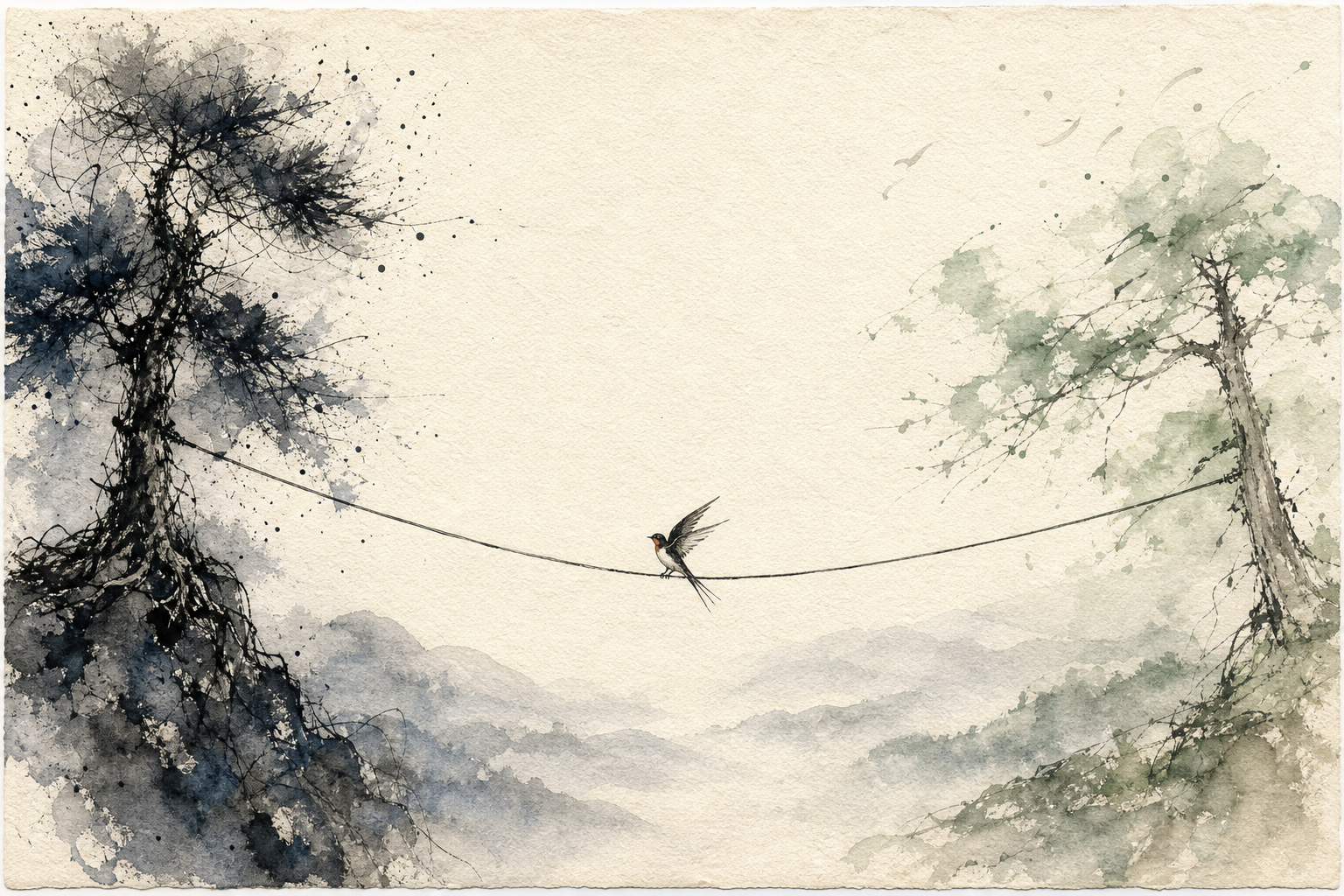
A student asks how reflection and contemplation can coexist with spontaneity, especially in relationships. The teacher describes a gradual process of pausing with reactivity, making room for fear and pain, and discovering the free, creative movement that emerges, using the image of learning to balance on a slackline.
Reactivity, Pause, and Spontaneity
A student asks how reflection and contemplation can coexist with spontaneity, especially in relationships. The teacher describes a gradual process of pausing with reactivity, making room for fear and pain, and discovering the free, creative movement that emerges, using the image of learning to balance on a slackline.
I have a quick question, if that's all right.
Of course.
What's the place between reflection, being contemplative, and spontaneity? How can you be both? Sometimes I'm reflecting, I'm thinking, but then I just want to be with this person.
I think that's a process. By process, I mean it's like learning an instrument. It takes time.
Where reactivity comes from
Normally we come from conditioning, attachment, and identification. Coming from there, there is distress and fear. From that place, most of the time, an attempt at spontaneity turns into reactivity. There will be unconscious behavior, conditioned behavior, just reacting from past conditioning.
Spontaneous reactiveness.
Yes. So there isn't true spontaneity there. It's pure reactivity. It's never black and white, but to a greater degree that's what it is.
Pausing with the impulse
Then comes this process of observing, observing, observing, which is also suppressing the reaction. By suppressing, I mean allowing the reaction to appear and to be known, but not acting on it. It's like creating a moment, creating a space where the impulse is withheld.
Could it be named as something like the need to dominate?
Yes. The need to dominate comes out of fear and pain. When the impulse to dominate appears, we can withhold it. Just pause and let the impulse to dominate be present with all of what it is, and it will be recognized that there is fear and pain.
So we create space for the fear, the pain, and the need to dominate, or whatever it is (in your example, the need to dominate). The more we do this, the more all of it is known and seen, and there is an okayness with it once we allow room for it. The need to dominate and control comes from "I'm not okay with the pain and fear I feel, so I'm going to dominate, take over, and have power, so I can stop the fear and pain I'm not okay with." But once I turn it around, this is the image of the beating heart of Christ: fear and pain, and it's okay.
Wisdom and discernment
But this again requires wisdom and discernment. If somebody is attacking me on the street, I don't stay there and get beaten up. I'm talking about situations where I'm having an argument with a relative, a partner, a son or a daughter, circumstances where I'm thinking, "I'm not going to have this." But really, what's the real danger? Am I about to get killed?
It could even be really simple situations at work, where someone is asked to do a task and there's an expectation.
Exactly. It's where the reaction brings up something that feels like life and death to us, and the reality is clearly not that. That's how we can gauge it. If I'm about to get run over by a bus, I'm not going to sit there contemplating the fear that comes up and watching what happens, because when a bus is coming right at me at top speed, the fear and the reality of life and death actually match pretty well.
So that's the discernment of circumstances. There's huge reactivity here: "I cannot handle this. I'm fundamentally not okay with this." And it's just an argument with a relative or a friend, or some work situation. That's where we pause and observe.
From okayness to new possibilities
Over time, as there is an okayness with the fear and the pain, there will be new possibilities of creative relationship and behavior, new ways of moving with what is, ways of speaking and acting that aren't reactive. When we start to be okay with the fear and pain and this starts to emerge, we make space for spontaneity. Spontaneity is an experiment: what if I do this instead of the usual thing? What if, instead of attacking, I relax, open up, listen more attentively, express care for the other person's pain and what they're telling me, and don't react?
That transforms relationships very fast, actually. I've had very close relationships, with parents, partners, siblings, where it seemed there was no way in this life that anything would ever change. And then, bam. What I truly thought was impossible in this life happened: complete transformation.
Then the spontaneity becomes more and more of a flow and an experiment. But there always need to be moments of "Ah, there's reactivity here, so I'm going to pause for a moment." That's the wisdom that starts to emerge. There is clear seeing of the reactivity, and an ability not to react in that moment because it is known as reactivity. There is pain and fear that can be met and held, and then it goes. When reactivity isn't there, there's spontaneity. But this process takes time.
Some relationships will require a lot more of this. Sometimes it's so hard not to react, so hard. And that's where it's most powerful for us not to react. It's powerful for those we're with too, as a consequence, but most powerful for us: to be able to hold that, to be with what we are running away from.
What we are running from
Because really, what we're running away from, through all identification, all obsession with thought, all that struggle, is feeling something we felt from very young and don't want to feel ever again. I'm spending my whole life not feeling the two or three little feelings I had when I was very young that I cannot bear. It really comes down to that. And they're really intense, "I'm going to die" intense. It's a child's excruciating fear and pain: "I'm about to die if you don't do this for me."
It takes a child time to know that.
Exactly. The more we do this, the more those deeper sensations start to appear. A child doesn't know whether it will die if it's not fed or comforted. For an adult, it's not the same thing, yet the feelings are the same, and they have remained within the same paradigm: this is life and death. Also, a baby's or young child's mind cannot hold presence and space for the energetics of those very deep forces of fear and pain, whereas a developed adult body-mind can.
It could recall the experience and question it.
The experiences will come. The experiences will come. We don't have to go hunting for difficult experiences. Just live your life fully, and difficult experiences will come. It goes in that direction, not the other way around. There's no need to hunt for them. Go for the most beautiful thing, and on that journey you will encounter plenty of challenges. So don't go looking for the difficult struggle.
Like self-flagellating monks trying to have Christ's resurrection experience by faking it.
Moving toward what you love
Right. Instead: What's your truth? What's your heart? What's your deepest longing in this life? What do you want most? What are you here for? Not "I'm here in order to do X, Y, and Z; it's a plan and I'm going to do it." No, bigger than that. Much deeper, much more divine. Profound.
But it could be very simple. It doesn't have to be grand. It could be "I just want to have a little house in the woods, walk my dogs every day, and look at the birds. That's all I want, and I'll do that till the end of time." Or raise my children, or whatever it is. More likely it will be something simple, or some form of creative endeavor, or some relationship. Something that is going outwards. It's not self-involved, not about me and for me. It's going outwards.
It is.
Thank you. In the example I gave of living in the woods and walking the dogs, I imagined a fictional person for whom that is the true desire. For that person, walking his or her dogs in the woods is the deep, real thing, and there's going to be an outpouring of love. Loving the dogs, loving the trees, loving the birds, and every person who comes close to that person will know and feel that love. That's why it's still going outwards. If it's "I want a little house in the mountains so nobody bothers me and I can be alone, because humans are difficult and painful," no, that's not it. That comes out of fear and pain.
It's always a deeper calling into something loving.
Yes. And don't look for a particular thing as the calling. I'm using images and metaphors, but it could be whatever is calling for life now. Where are the beauty and joy in you, in this life, now? Again, it can be very simple. It can be playing golf and being with your friends, and a year from now it's different, it has changed. It's not a big thing. Or it could be writing in a journal and sharing it with some friends, or playing music. I could sit for two hours and come up with different things every second. And it could be none of that for you. It's whatever comes from you.
Coming from okayness, not fixing
What it is not is something you'll only be okay with if you get there tomorrow or the day after. That comes out of fear and pain. It should come from "This is beautiful. Being here is beautiful. How do I express the beauty and joy I experience in this? What brings me joy, what feels inspiring and exciting, loving and beautiful?" So it comes from the experience of the okayness and goodness of this moment, not as a way to fix what's wrong with this moment.
It could still change and improve what is here now. But if it's because what's here now is really wrong, and I'm not okay until it changes, that's not it. If I'm completely in love with this, and I also see a lot of problems and unnecessary struggle and pain in society and humanity, and I feel I have the talent and ability to creatively improve things, then yes, that sounds like a good direction. Or maybe it's not about improving anything for anybody, like the woman in the forest with her dogs.
Basically, it's just experimentation with life.
Yes, exactly. It's an experiment, because there's a constant dance and flow, with constant feedback: yes, this is flowing; no, this is not; yes, this is flowing; no, this is not. Even if there's effort, say my thing is climbing mountains, there's an effortlessness to it, a joy and pleasure in that effort.
And if things become difficult and painful, it doesn't mean it's not it. One can still look and say, "This is definitely hard right now, but setting today aside, is this the direction I want to keep dancing towards? Yes." When there are challenges and difficult situations, one can start developing the fear of not being okay. But one can ask: if whatever challenge is happening now comes and goes, and I am okay, is this still a direction I'm interested in?
The slackline
Beautiful. I see that a lot with slacklining, which I'm learning. I fall down so many times, but part of the falling is getting up, balancing again, trying to stand again.
That's a perfect example. My teacher used to talk about that a lot. There's a story about two rabbis. One of them walks on a tightrope, back and forth, back and forth. The other one tries and falls, and asks, "How do you do it? What is your technique?" He answers, "I don't know. I just lean to one side or lean to the other, depending." Lean to one side or lean to the other: that's the technique.
That's slacklining. It's the perfect metaphor for what we're talking about, the dance and the flow. If you fall, you get back up, lean to one side, lean to the other, and you start to acquire the wisdom of sensitivity: listening, feeling, knowing, and seeing all the reactivity and what's happening, and recognizing, "Ah, a little bit to the left, a little bit to the right," metaphorically.
And that is very spontaneous. When you start on the slackline, your body makes all the reactive movements of walking, and that doesn't work; you go straight down. But when you suppress those reactions, you start to find something, and then there's a very spontaneous flow of balance. Anyone who has done slacklining knows this: you get on it and your body tries to react in ways that simply don't work there. It's not like being on the floor. All of those behaviors need to be suppressed. It's like riding a bicycle, a whole different way of balancing. But once the balance is learned, it's very spontaneous. You're not thinking about how to turn right or left on a bicycle, what movement to make, where to put your weight, which muscle to use. You just feel like going right, and everything goes right.
I can imagine myself a year or two ago doing it and just getting pissed off, annoyed. The reaction.
Yes. But that's a great learning, a great lesson. Apply that learning to everything in your life. Really, apply it to everything.
That's why I thought it was a perfect example, because of relationships, and seeing how they go up and down and change.
Yes, because we repeat the same behaviors expecting different results. What's the saying? Madness is repeating the same action and expecting different results.
Right. We keep doing the same thing in a reactive way.
And you cannot keep getting the same slap in the face from the ground. Face to the ground.
Thank you so much. This is very valuable.
You're very welcome. It's been a very fun chat.